Quantum Computing: Revolutionizing Industry and Science

We can imagine a world where quantum computers will be able to design powerful new drugs by simulating the behaviour of individual molecules, and optimize complex supply chains to help companies source the parts they need and assemble products in the most efficient way possible.

Introduction

Quantum computing is an entirely new dimension of computing leveraging the laws of quantum mechanics. Quantum computers apply superposition and entanglement at the universe’s smallest scales and coldest temperatures. They also adopt a multidisciplinary approach comprising of computer science, physics and mathematics to enable scientist to solve complex problems.

While today’s quantum computers remain rudimentary and error-prone, they have the potential to provide significant performance gains, and dramatically increased computation speeds to perform complex computational tasks that can take classical computers years to complete. Numerous governments, universities and vendors around the world are investing heavily in harnessing quantum computing technology to achieve fault-tolerant and reliable systems.

In this article, I provide a detailed examination of the key concepts underlying quantum computers, and how they promise to open the potential for massive advancements in a variety of scientific and industrial applications.

Superposition and entanglement

Qubits are the most basic units of processing in quantum computers. Qubits rely on the use of particles such electrons and photons, that can be suspended in states of 0, 1 or any states in between. This ability of qubits to be in more than one state at a time is what gives quantum computers their processing power. However, it is the application of superposition and entanglement through interference to qubits that allow quantum computers to produce reliable outcomes.

To better understand superposition, we refer to the famous thought experiment involving a cat as imagined by the physicist, Erwin Shrödinger. Shrödinger’s experiment imagined a cat sealed in a box with a poison trap that can be triggered by a decaying radioactive atom. Since the decay of the radioactive atom is uncertain, at any given moment the cat could be in a superposition of states such that it is either dead or alive [1]. It is only when someone opens the box and observes the cat does its state become definite or its state “collapses” to being either dead or alive.

Superposition is difficult to explain through analogies; however it is also possible to imagine a coin tossed and spinning fast in the air. As long as the coin continues spinning then its state can be considered both heads and tails. It is only when the coin is stopped does one observe its state as either heads or tails.  

Quantum theory also implies that particles can be linked with each other, such that when the state of one particle changes it will instantly impact the state of the other, regardless of the distance between them. This is what is referred to as entanglement, and it is what allows qubits to correlate their states with each other and thus scale their processing power exponentially.

In Shrödinger’s cat experiment, entanglement can be described as having several cats in the box that are entangled in a superposition of states such all cats in the box are either dead or alive. When someone opens the box, their state then collapses such that the cats in the box are all observed to be either dead or alive. Entanglement means that two particles are always connected, and they are never independent of each other. This is how nature works at the atomic level.   

Interference

Quantum interference refers to a phenomenon where the probability amplitudes of quantum states combine, either constructively or destructively, to influence the likelihood of an outcome. In classical interference, physical waves such as sound or water can overlap such that they amplify or cancel each other out. Quantum interference is different in that is it based on the wave-like behaviour of particles such as electrons, photons and atoms [2].

In quantum theory, particles are described via wavefunctions, which contain complex-value probability amplitudes. We can think of a particle going through two indistinguishable paths such as two slits in a barrier as the two-slit experiment describes. In this experiment, particles such as photons or electrons are fired one at a time at a wall with two narrow slits and a screen placed behind it. Each particle must pass through slit A, slit B or a combination of both. The expectation would be that particles would pass through one slit or the other, and that the screen would show two bright spots as the particles pass through.

Instead of observing two spots on the screen, a series of bright and dark fringes are observed – an interference pattern. The fringe pattern is characteristic of the behaviour of waves rather than particles, where the bright areas indicate wave amplitudes that amplified each other, while the dark ones are waves that canceled out. This behaviour can be described as [3]:

  • Constructive interference, where the wave amplitudes add up, thus increasing the probability of a particular outcome.
  • Destructive interference, where the amplitudes cancel each other out, thus reducing or eliminating the chance of an outcome.

What is fascinating about the fringe pattern observed is that it can appear even when particles are sent one at a time. Therefore, instead of interfering with each other particles are interfering with themselves, thus taking both paths simultaneously in superposition.

Interference is what gives quantum computers their superiority over classical computers. It allows quantum systems to guide computations by enhancing the probability of correct answers while supressing wrong ones. Once qubits are transformed and entangled, their probability amplitudes evolve through interference. All possible computations are performed simultaneously and are allowed to interact through entanglement.

A critical condition of interference is that the paths followed by qubits are indistinguishable, such that it is not possible to determine which path a qubit takes, even in principle. Any form of measurement collapses the wavefunction, thus destroying the superposition and possibility of interference. Interference underlies the power of quantum computing, and it remains a key component in unlocking the full potential of quantum technology.

Measurement

In the final stage of quantum computing, states collapse into classical outcomes upon measurement. These outcomes are not random and are fundamentally determined by whether computational paths leading to them have interfered constructively or destructively.

A state where computational paths leading to it have interfered destructively will have a probability close to 0. Similarly, a state where computational paths leading to it have interfered constructively will have a significantly amplified likelihood.

Instead of measuring outcomes sequentially, quantum computers exploit the wave-like nature of qubits to allow all possible computational paths to co-exist and interfere. This creates a probabilistic landscape where the correct answers become the most likely outcomes.

Quantum bits (Qubits)

Computers process information using bits that store information using 0’s and 1’s. Bits can be represented using physical objects such as bar magnets or switches placed in either a state of up or down. Bits can maintain their state for a long time, thus allowing them to represent stored information in a stable and long-lasting fashion. However, bits are limited in their ability to store information when compared to qubits. While bits can exist in either a stare of 0 or 1, qubits can exist in a superposition of multiple states of 0, 1 or any state in between.

The superposition of qubits is what makes them superior to classical bits. It is possible to think of a qubit as an electron spinning in a magnetic field. The electron could be spinning with the field, known as spin-up state, or against the field, knows as spin-down state. Suppose it is possible to change the direction of the electron’s spin using a pulse of energy such as a laser. If only half a pulse of laser energy is used and all external influences are isolated, then we can imagine the electron in superposition where it is in all possible states at once [4].

Superposition increases the computational power of qubits exponentially depending on the number of qubits in a quantum computer. Whereas two classical bits can contain only two pieces of information (01 and 10), two qubits can store a superposition of four combinations of 0 and 1 simultaneously, three qubits can store eight combinations, and so on. Therefore, a quantum computer can perform 2N computations, where N is the number of qubits.

Conclusion

Through exponential scaling, unique algorithms and the continued evolution of quantum hardware, quantum computing has the potential to revolutionize industries like cryptography, material science, pharmaceuticals and logistics. We can imagine a world where quantum computers will be able to design powerful new drugs by simulating the behaviour of individual molecules, and optimize complex supply chains to help companies source the parts they need and assemble products in the most efficient way possible. Other more impactful applications could be computers that could break the encryption that safeguards our private information on the internet.

Governments, companies and research labs are working tirelessly to harness the potential of this emerging technology. Quantum computing, combined with the capabilities and advancements in AI, has the potential to achieve artificial general intelligence (AGI). By enabling rapid data processing and computation, improved learning capabilities and parallel processing, quantum computers can process extensive datasets, enabling the improved learning capabilities needed for AGI. As quantum computers continue to rapidly evolve, it is essential for us to harness their potential in ways that further advance humanity’s future and well-being.

References

[1] Quantum Computing Explained

[2] What is quantum interference and how does it work?

[3] Quantum interference in Quantum Computing: 2025 Full Guide

[4] What is quantum computing? How it works and examples

The Principles of Quantum Computing Explained

Today, a variety of companies are producing mainstream quantum hardware and making tools available to developers, turning quantum computing technology that was theoretical a few decades ago into a reality.

Introduction

During one of his Messenger Lectures at MIT in 1964, the renowned Nobel prize laureate and theoretical physicist, Richard Feynman, was quoted as saying “I think I can safely say that no one can understand quantum mechanics”. Feynman emphasized the counter intuitiveness of quantum mechanics, and encouraged listeners at his lecture to simply accept how atoms behave at the quantum level, rather than trying to apply a classical understanding onto it [1].

At its core, quantum theory describes how light and matter behave at the subatomic level. Quantum theory explains how particles can appear in two different places at the same time, how light can behave both as a particle and a wave, and how electrical current can flow both clockwise and counter-clockwise in a wire. These ideas can seem strange to us, even bizarre, yet quantum mechanics gave rise to a new world of possibilities science, technology and information processing.

What is a quantum computer?

While classical computers use bits that can be either 0 or 1, quantum computers use quantum bits (qubits) that can be 0, 1 or both at the same time, suspended in superposition. Qubits are created by manipulating and measuring systems that exhibit quantum mechanical behaviour. Because qubits can hold superposition and exhibit interference, they can solve problems differently than classical computers.

Quantum computers perform quantum computations by manipulating the quantum states of qubits in a controlled way to perform algorithms [2]. Quantum computers can adopt an arbitrary quantum state from an arbitrary input quantum state. This enables quantum computers to accurately compute the behaviour of small particles that follow the laws of quantum mechanics, such as the behaviour of an electron in a hydrogen molecule. Quantum computers can also be used to efficiently run optimization and machine learning algorithms.

For example, a classical computer might apply a brute force method to solve a maze by trying every possible path and remembering the paths that don’t work. A quantum computer, on the other hand, may not need to test all paths in the maze to arrive at the solution. Instead, given a snapshot of the maze, a quantum computer relies on measuring the probability amplitudes of qubits to determine the outcome. Since the amplitudes behave like waves, the solution is found when the waves overlap.

Principles of quantum computing

Quantum computing relies on four key principles:

Superposition – represents all possible combinations of a qubit through a complex multi-dimensional computational space. Superposition allows the representation of complex problems in new ways using these computational spaces. The quantum state is measured by collapsing it from the superposition of possibilities into a binary state that can be registered as binary code using 0 and 1[3].   

Entanglement – the ability of qubits to correlate their state with other qubits. Entanglement implies close connections among qubits in a quantum system, such that each qubit can immediately determine information about other qubits in the system.

Interference – qubits placed in a state of collective superposition structure information in a way that looks like waves, with amplitudes associated with each wave. These waves can either peak at a particular level or cancel each other out, thus amplifying the probability or canceling it out for a specific outcome. Amplifying or canceling out a probability are both forms of interference.

Decoherence – occurs when a system collapses from a quantum state to a non-quantum state. This can be triggered intentionally through measurement of the quantum system or other unintentional factors. Quantum computers require avoiding or minimizing decoherence.                 

Combining these principles can help explain how quantum computers work. By preparing a superposition of quantum states, a quantum circuit written by the user uses operations to entangle qubits and generate interference patterns, as governed by a quantum algorithm. Outcomes are either canceled out or amplified through interference, and the amplified outcomes serve as the solution to the computation.

Conclusion

Today, a variety of companies are producing mainstream quantum hardware and making tools available to developers, turning quantum computing technology that was theoretical a few decades ago into a reality. Superconducting quantum processors are being delivered at regular intervals, increasing quantum computing speed and capacity. Researchers are continuing to make quantum computers even more useful, while overcoming challenges related to scaling quantum hardware and software, quantum error correction and quantum algorithms.


Designing solutions that work for users is what fuels my work. I’d love to connect and talk through your design ideas or challenges, connect with me today on LinkedIn or contact me at Mimico Design House.


References

[1] Quantum Mechanics by Richard P. Feynman

[2] The basics of Quantum Computing

[3] What is quantum computing?

Applying the EPIS framework to Dashboard Design and Implementation 

Introduction 

In a previous post, I discussed the various types of dashboards and the design principles and best practices for dashboard design and development [1]. I highlighted how the Exploration, Preparation, Implementation and Sustainment (EPIS) framework has proven to be an effective methodology to ensure the proper application of user-centered design methodology and implementation science to dashboard design.   

Through a structured four-phase approach, EPIS ensures that dashboards are designed with a deep understanding of the user problems and needs. It also ensures that dashboards remain usable and provide the most value and impact through proper initiation and monitoring post implementation.  

Through its application of the multi-phased approach to new interventions and technologies, EPIS further strengthens the opinions I expressed in my previous post, that a well-designed dashboard can become a co-pilot and an effective tool in enabling users to gain insights and make key decisions. When properly applied to dashboard design, EPIS can help establish the foundation and architecture for the entirety of the application the dashboard serves. 

The EPIS framework 

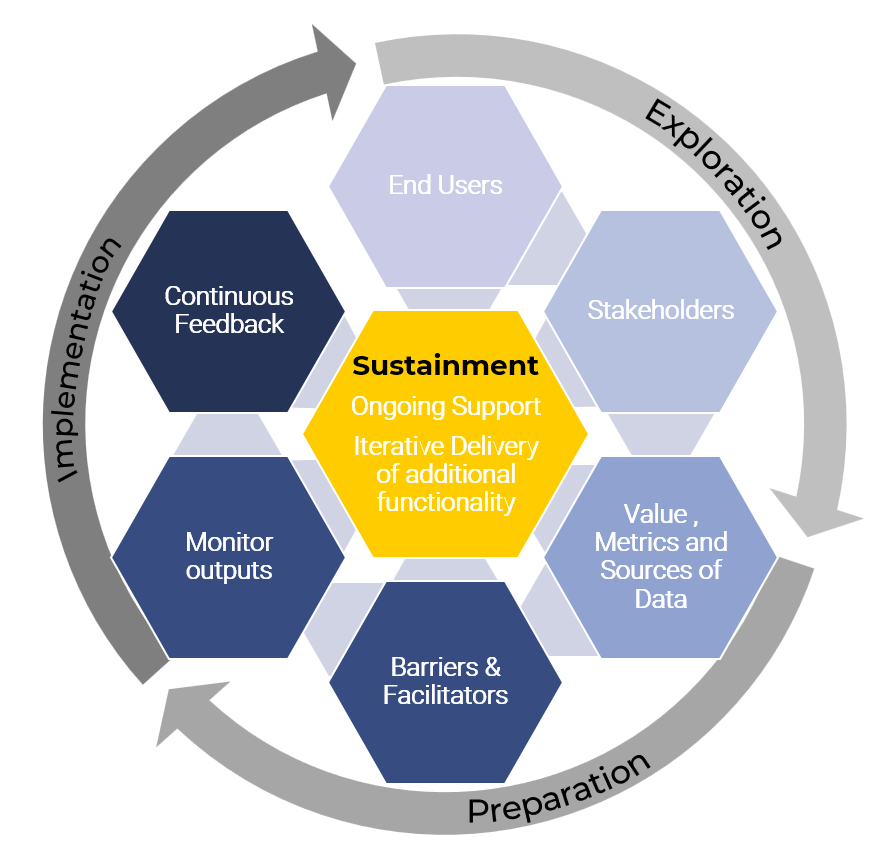
EPIS comprises of four phases that align well with the design and implementation of a dashboard through clear identification of outer systems and inner organizational contexts [2]. Even though the EPIS framework starts with exploration, it is important to consider the sustainment phase as work progresses throughout the different phases. This ensures that the dashboard is designed and developed with sustainability in mind. The EPIS framework consists of four phases: 

Exploration – this phase is informed both by user-centered design methodology and implementation science to identify the data metrics and functionality the dashboard must offer. The process begins by identifying the actors and conducting interviews to further understand their needs, and what data metrics would be most useful to them. Interviews may be guided by the Consolidated Framework for Implementation Research (CFIR), which provides a taxonomy and structure for evaluating implementation factors across multiple contexts [3][4]. CFIR consists of five domains that include intervention characteristics, outer and inner settings, characteristics of individuals and process. These domains inform the collection and assessment of user feedback and provide a framework for documenting decisions and evaluating outcomes.  

Preparation – the preparation phase considers the data metrics identified and their value, including any interoperability and dependencies among the identified metrics. Barriers and facilitators to implementation are also identified to ensure that data metrics can be implemented with the proper frameworks for coaching, audit and feedback, and that they promote effective decision-making. It is also important to consider data sources and their ease of access. Any lag or performance issues in accessing the data are also identified and addressed. 

Implementation – during implementation, the value, accuracy, interoperability and clarity of the data metrics identified are continuously monitored. Ongoing needs assessment and monitoring of barriers to implementation are also conducted. It is important to continuously seek end user feedback throughout the implementation phase on users’ understanding and interpretation of the data metrics and functionality added to the dashboard. This can be achieved through user interviews, surveys and usability testing sessions.  

Sustainment – the sustainment phase ensures the continued delivery of the dashboard, its associated data metrics, and functionality through an iterative design and evaluation process. A set of important outcomes is established based on the purpose of the dashboard and the user feedback gathered during the preparation phase. The sustainment phase provides ongoing support to ensure that the dashboard delivers the outcomes it was designed to do based on its purpose.  

Figure 1. The EPIS framework.

Applying EPIS to dashboard design 

Applying the EPIS framework to dashboard design emphasizes the application of user-centered design methodology especially during the exploration and preparation phases, while implementation science supports the implementation and sustainment phases.  

In [4] the authors highlight eight recommendations for enhancing dashboard use in the context of EPIS: 

  1. Determine data metrics and value of data accuracy – this applies to all phases and requires identifying data metrics of value to all actors. The actors identified can include end users who may interact directly with the dashboard, and other stakeholders who may not interact directly with the dashboard but may be impacted by it. It is also important to consider the sources of data used and their degree of data accuracy. 
  1. Data interpretability and clarity – applied during the preparation and implementation phases, this recommendation involves assessing potential unintended consequences and monitoring user interpretation of data to ensure accuracy.  
  1. Early and ongoing multi-level needs assessment/identification of implementation barriers and facilitators – applied during the exploration, preparation and implementation phases, this recommendation ensures that designers conduct an ongoing assessment of the needs of all relevant actors who may be exposed to the dashboard or may be impacted by it.  
  1. Design for equity – applied during the preparation and implementation phases, this recommendation addresses any potential data biases and considers the impact of the dashboard on diverse populations. Data presented on the dashboard must reflect the needs of the diverse populations that may be exposed to it.  
  1. Usable and intuitive dashboard components – during the preparation and implementation phases, it is important to ensure that dashboard components are intuitive and easy to understand when visualizing data. The dashboard must be user-friendly, intuitive, easy to understand and visually appealing without requiring the users to seeks assistance to interpret the data.  
  1. Iterative design and evaluation – the preparation, implementation and sustainment phases must incorporate an iterative dashboard design and evaluation process. This is accomplished through frequent usability testing to gather feedback from users and updating the design to address any usability gaps identified.  
  1. Consider appropriate outcomes – during the preparation, implementation and sustainment phases, it is critical that an appropriate set of outcomes is identified depending on the purpose of the dashboard. The dashboard may serve as an enabler for intervention or as the provider of the implementation strategy for intervention. An intervention dashboard is critical for delivering outcomes such that it would significantly impact the effectiveness of those outcomes if it is removed from practice. Implementation strategy dashboards provide insights that support the implementation of an intervention. They assist the user by delivering performance data to inform decisions or behaviours. 
  1. Plan for sustainment – even after the dashboard in implemented and is in use, it is important to develop a plan to ensure the sustained use of the dashboard over the long run. This involves frequent engagement of users to learn about any gaps or barriers to use and proposing solutions to those barriers. The sustainment plan should also consider the short- and long-term needs of users to ensure the dashboard continues to offer value over time.   

Conclusion 

The EPIS framework was developed to address challenges in implementing data-driven solutions in public service environments including child welfare, social services and health care. It has proven to be an effective framework for developing dashboards for any type of application, and a leading guide for the adoption of user-centred methodology and implementation science in the design and development of context-sensitive dashboards. As the framework continues to be refined and adapted to diverse research, policy and practice settings it will continue to establish itself as the foundation for the design and development of usable and sustainable dashboards.  


Designing solutions that work for users is what fuels my work. I’d love to connect and talk through your design ideas or challenges, connect with me today on LinkedIn or contact me at Mimico Design House.


References 

[1] Dashboards Drive Great User Experience 

[2] What is EPS?  

[3] Smith LR, Damschroder L, Lewis CC, Weiner B. The Consolidated Framework for Implementation Research: advancing implementation science through real-world applications, adaptations, and measurement. Implement Sci. 2015;10(Suppl 1):A11. Published 2015 Aug 20. doi:10.1186/1748-5908-10-S1-A11 

[4] Rossi FS, Adams MCB, Aarons G, McGovern MP. From glitter to gold: recommendations for effective dashboards from design through sustainment. Implement Sci. 2025;20(1):16. Published 2025 Apr 22. doi:10.1186/s13012-025-01430-x 

Dashboards Drive Great User Experience

A dashboard must enable the user to gain the information and insights they need “at a glance”, while also enabling them to better perform their tasks, and enhance their user experience overall. 

Introduction 

Whenever I drive my car, I am reminded of how its dashboard allows me to maintain control and remain aware of all the actions I need to take, while also being able to pay attention to my driving. My car’s dashboard indicates critical information to me like speed, engine oil temperature, and fuel level among other critical information. As the driver, it is essential for me to remain aware of these data points while I focus on the important task of driving, and the actions of other drivers around me.  

Like many applications, a car’s dashboard provides insight into the car’s inner workings in a user-friendly and intuitive manner, allowing the user to see and act upon information without needing to understand the technical details or the engineering behind it. This is why designing an application around a dashboard, not the other way around, makes sense in ensuring that the application’s features all cater to the data and information needs of the user.  

It is possible to architect an entire application and its features by thinking about the various components that exist on the dashboard, what information they will convey, and how the user will interact with these components. When a dashboard is designed around the user’s needs, the various components of the application must be designed such that they enable the dashboard components to receive the input they need and output the data users expect.  

In the age of AI-focused applications that require the design and development of models to support business requirements and deliver valuable insights, designing an effective dashboard focuses AI teams efforts on building models that deliver impactful output, reflected on the dashboard. 

Types of dashboards 

Dashboard can vary depending on user needs. Those needs can vary depending on whether the dashboard must enable high-level or in-depth analysis, the frequency of data updates required, and the scope of data the dashboard must track. Based on this, dashboards can be categorized into three different categories [1]: 

  • Strategic dashboards: Provide high-level metrics to support making strategic business decisions such as monitoring current business performance against benchmarks and goals. An example metric would be current sales revenue against targets and benchmarks set by the business. A strategic dashboard is mainly used by directors or high-level executives who rely on them to gain insights and make strategic business decisions.  
  • Operational dashboards: Provide real-time data and metrics to enable users to remain proactive and make operational decisions that affect business continuity. Operational dashboards must show data in a clear and easy to understand layout so that users can quickly see and act upon the information displayed. They must also provide the flexibility for users to customize notifications and alerts so that they do not miss taking any important actions. For example, airline flight operations planners may require the ability to monitor flight status and be alerted to potential delays. Some of the metrics a dashboard could show in this case are the status of gate, crew or maintenance operations. 
  • Analytical dashboards: Analytical dashboards use data to visualize and provide insight into both historical and current trends. Analytical dashboards are useful in providing business intelligence by consolidating and analyzing large datasets to produce easy to understand and actionable insights, specifically in AI applications that use machine learning models to product insights. For example, in a sales application the dashboard can provide insight into the number of leads and a breakdown of whether they were generated through phone, social media, email or a corporate website.  

Design principles and best practices 

Much like a car dashboard, an application dashboard must abstract the complexities of the data it displays to enable the user to quickly and easily gain insights and make decisions. To achieve these objectives, the following design principles and best practices should be considered.  

  • Dashboard “architecture”: It is important to think about what the dashboard must achieve based on the dashboard types describes above. Creating a dashboard with clarity, simplicity, and a clear hierarchy of data laid out for quick assessment, ensures that the information presented on the dashboard does not compete for the user’s attention. A well architected dashboard does not overwhelm the user such that they are unable to make clear decisions. It acts as a co-pilot producing all the information the user needs, when they need it.  
  • Visual elements: Choosing the correct visual elements to represent information on the dashboard ensures that the user can quickly and easily interpret the data presented. Close attention should be paid to: 
    • Using the right charts to represent information. For example, use a pie chart instead of a bar chart if there is a need to visualize data percentages. 
    • Designing tables with a minimal number of columns such that they are not overwhelming to the user, making it harder to interpret them. 
    • Paying attention to color coding ensures that charts can be easily scanned without the user straining to distinguish between the various elements the charts represent. It is also important to ensure that all colors chosen contrast properly with each other and that all text overlaid on top of the charts remains easy to read and accessible. 
    • Providing clear definitions for symbols and units ensures no ambiguity as to how to interpret the data presented on the dashboard. 
  • Customization and interactivity: Providing users with the flexibility to customize their dashboard allows them to create a layout that works best for their needs. This includes the ability to add or remove charts or tables, the ability to filter data, drill down and specify time ranges to display the data, where applicable.  
  • Real-time updates and performance: Ensuring that dashboard components and data update quickly and in real-time adds to the dashboard usability and value. This is best achieved by ensuring an efficient design to the dashboard components, such that they display only the information required unless the user decides to interact with them and perform additional filtering or customization. 

When implementing dashboards, the Exploration, Preparation, Implementation and Sustainment (EPIS) framework provides a roadmap for designers and developers to design and develop effective dashboards [2]. Combining human-centered methodology during the exploration and preparation phases of EPIS ensures that the dashboard meets users’ needs and expectations, while implementation science methods are especially important during the implementation and sustainment phases [3]. Care must be taken when implementing dashboards and EPIS provides an excellent framework that will be discussed in more detail in a subsequent article.  

Conclusion 

I always admire the design, layout, and clarity of the information presented to me on my car’s dashboard. The experience I receive when driving my car, through the clear and intuitive design of its dashboard components and instruments, makes every drive enjoyable. All the information I need is presented in real-time, laid out clearly and placed such that it allows me to focus on the task of driving while also paying attention to how my car is behaving. I can adjust, tune and customize the dashboard components in a way that further enhances my driving experience and adds to my sense of control of the car. 

The properties of a car dashboard reflect exactly how an application dashboard must behave. While the user of an application may be using the dashboard under a different context than driving a car, the principles of user experience, interaction design and overall usability still apply. A dashboard must enable the user to gain the information and insights they need “at a glance”, while also enabling them to better perform their tasks, and enhance their user experience overall.  


Designing solutions that work for users is what fuels my work. I’d love to connect and talk through your design ideas or challenges, connect with me today LinkedIn or contact me on Mimico Design House.

References 

[1] Dashboard Types Guide: Strategic, Operational, Tactical + More 

[2] Aarons GA, Hurlburt M, Horwitz SM. Advancing a conceptual model of evidence-based practice implementation in public service sectors. Adm Policy Ment Health. 2011;38(1):4–23. 

[3] From glitter to gold: recommendations for effective dashboards from design through sustainment 

How To Build Large Language Models

Introduction 

Large Language Models (LLMs) are Artificial Intelligence algorithms that use massive data sets to summarize, generate and reason about new content. LLMs are built on a set of neural networks based on the transformer architecture. Each transformer consists of encoders and decoders that can understand text sequence and the relationship between words and phrases in it. 

The generative AI technologies that have been enabled by LLMs have transformed how organizations serve their customers, how workers perform their jobs and how users perform daily tasks when searching for information and leveraging intelligent systems. To build an LLM we need to define the objective of the model and whether it will be chatbot, code generator or a summarizer.  

Building an LLM 

Building an LLM requires the curation of vast datasets that enable the model to gain a deep understanding of the language, vocabulary and context around the model’s objective. These datasets can span terabytes of data and can be grown even further depending on the model’s objectives [1].  

Data collection and processing 

Once the model objectives are defined, data can be gathered from sources on the internet, books and academic literature, social media and public and private databases. The data is then curated to remove any low-quality, duplicate or irrelevant content. It is also important to ensure that all ethics, copyright and bias issues are addressed since those areas can become of major concern as the model develops and begins to produce the results and predictions it is designed to do. 

Selecting the model architecture 

Model selection involves selecting the neural network design that is best suited for the LLM goals and objectives. The type of architecture to select depends on the tasks the LLM must support, whether it is generation, translation or summarization.  

  • Perceptrons and feed-forward networks: Perceptrons are the most basic neural networks consisting of only input and output layers, with no hidden layers. Perceptrons are most suitable for solving linear problems with binary output. Feed-forward networks may include one or more layers hidden between the input and output. They introduce non-linearity, allowing for more complex relationships in data [2]. 
  • Recurrent Neural Networks (RNNs): RNNs are neural networks that process information sequentially by maintaining a hidden state that is updated as each element in the sequence is processed. RNNs are limited in capturing dependencies between elements within long sequences due to the vanishing gradient problem, where the influence of distant input makes it difficult to train the model as their signal becomes weaker.   
  • Transformers: Transformers apply global self-attention that allows each token to refer to any other token, regardless of distance. Additionally, by taking advantage of parallelization, transformers introduce features such as scalability, language understanding, deep reasoning and fluent text generation to LLMs that were never possible with RNNs. It is recommended to start with a robust architecture such as transformers as this will maximize performance and training efficiency. 
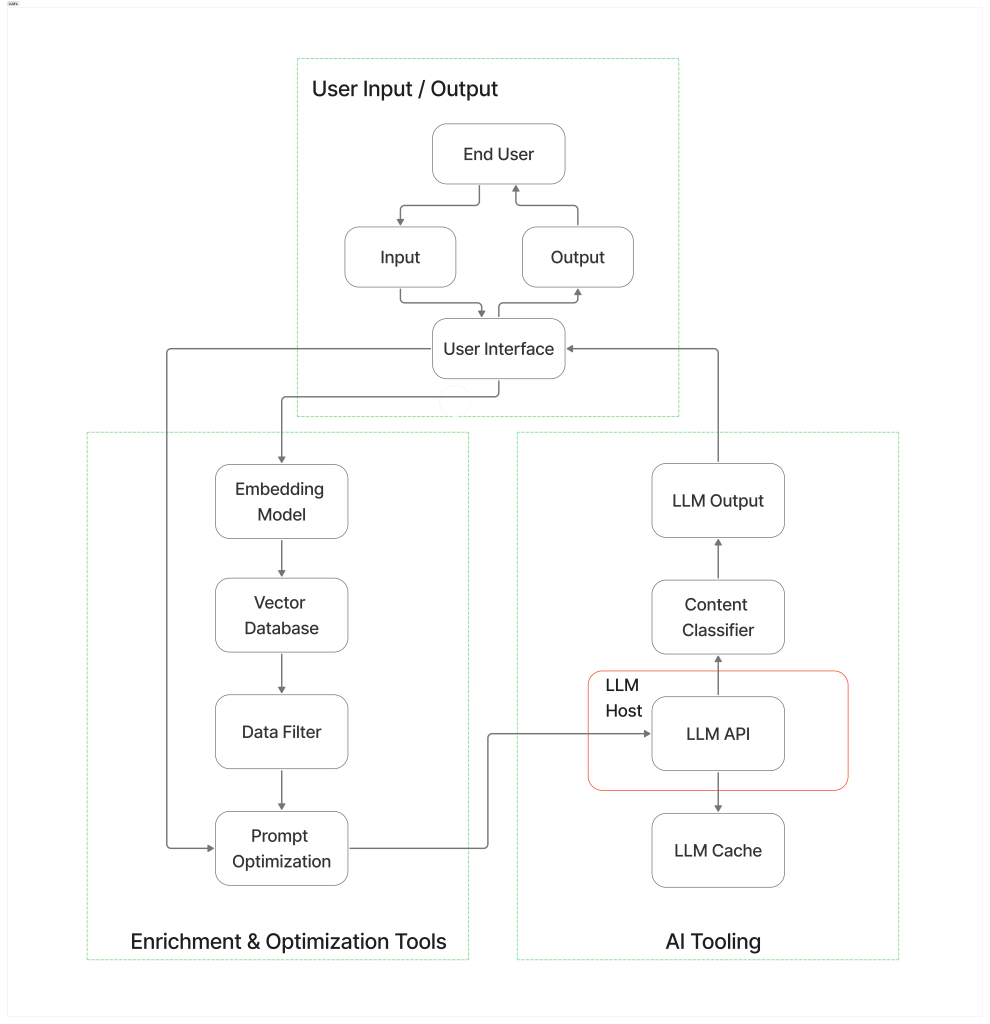
Figure 1. Example of an LLM architecture [3].

Implementing the model 

Implementing the model requires using a deep learning framework such as TensorFlow or PyTorch to design and assemble the model’s core architecture [4]. The key steps in implementing the model are: 

  • Defining the model architecture such as transformers and specifying the key parameters including the number of heads and layers.  
  • Implementing the model by building the encoder and decoder layers, the attention mechanisms, feed-forward networks and normalizing the layers.  
  • Designing input/output mechanisms that enable tokenized text input and output layers for predicted tokens. 
  • Using modular design and optimizing resource allocation to scale training for large datasets. 

Training the model 

Model training is a multi-phase process requiring extensive data and computational resources. These phases include: 

  1. Self-supervised learning where the model is fed massive amounts of data, so that it can be trained in language understanding and predicting missing words in a sequence.  
  2. Supervised learning where the model is trained to understand prompts and instructions allowing it to generalize, interact and follow detailed requests.  
  3. Reinforcement learning with Human Feedback (RLHF) involves learning with human input to ensure that output matches human expectations and desired behaviour. This also ensures that the model avoids bias and harmful responses and that the output is helpful and accurate.  

Fine tuning and customization 

Customization techniques include full model fine-tuning where all weights in the model are adjusted to focus on task-specific data. It is also possible to fine-tune parameters and engineer prompts to focus on smaller modules, saving resources and enabling easier deployment.  

Training a pre-trained model based on domain-specific datasets allows the model to specialize on target tasks. This is easier and less resource-intensive than training a model from scratch since it leverages the base knowledge already learned by the model. 

Model deployment 

Deploying the LLM makes it available for real-world use, enabling users to interact with it. The model is deployed on local servers or cloud platforms using APIs to allow other applications or systems to interface with it. The model is scaled across multiple GPUs to handle the growing usage and improve performance [5]. The model is continually monitored, updated and maintained to ensure it remains current and accurate.   

Ethical and legal considerations 

The ethical and legal considerations are important in the development and deployment of LLMs. It is important that the LLM is unbiased and that it avoids propagating unfair and discriminatory outputs. This extends to discriminatory and harmful content which can be mitigated through reinforcement learning with human feedback (RLHF).  

Training data may contain sensitive and private information, and the larger the datasets used to train the model the greater the privacy risks they involve. It is essential that privacy laws are adhered to and followed to ensure the models can continue to evolve and develop while preventing unintended memorization or leakage of private information. 

Copyright and intellectual property must also be protected by ensuring that the proper licenses are obtained. Regular risk and compliance assessments and proper governance and oversight over the model life cycle can help mitigate ethical and legal issues.  

Conclusion 

Developing and deploying an LLM in 2025 requires a combination technical, analytical and soft skills. Strong programming skills in Python, R and Java are critical to AI development. A deep understanding of machine learning and LLM architectures including an understanding of the foundational mathematical concepts underlying them, are also critical. It is also important to have a good understanding of hardware architectures including CPUs, GPUs, TPUs and NPUs to ensure that the tasks performed by the LLM are deployed on the most suitable hardware to ensure efficiency, scalability and cost-effectiveness.    

Other skills related to data management, problem-solving, critical thinking, communication and collaboration, and ethics and responsible AI are also essential in ensuring the models remain useful and sustainable. 

References 

[1] The Ultimate Guide to Building Large Language Models 

[2] Feedforward Neural Networks 

[3] The architecture of today’s LLM applications  

[4] How to Build a Large Language Model: A Comprehensive Guide 

[5] Large Language Model Training in 2025