
The retail landscape is being quickly transformed by Agentic AI programs that are driving a competitive race to lead in autonomy, speed and personalized customer experiences. In 2025, retailers cannot afford not to move quickly and aggressively in implementing agentic AI in all business functions or they risk being left behind, or worse, forced to exit.
Introduction
AI agents are redefining retail and are evolving into autonomous assistants that plan, recommend and take action. One of the most prominent examples of this shift is Walmart’s “Sparky”, a conversational AI shopping assistant in the mobile app that can understand customers shopping needs, suggest relevant products, answer questions and provide recommendations based on preferences [1]. Walmart is betting big on AI to drive its e-commerce growth and is aiming for online sales to account for 50% of its total sales [2].
Amazon, another retail giant, is using AI on a different scale by creating a harmonious ecosystem of AI and Machine Learning (ML) models across the different functional areas of the business. For example, demand forecasting is accomplished using models that leverage sales history, social media, economic trends and weather to predict demand more accurately. Machine learning (ML) algorithms use data across the supply chain to optimize stock levels and replenishment strategies to ensure alignment with predicted demand. Amazon is also using AI to automate inventory management and using AI-driven robots to manage the movement of good within warehouses. Other AI models optimize delivery routes in real-time using inputs like traffic conditions and weather among other factors [3].
Retailers that make use of AI and ML will ensure they maintain a competitive edge, and those that do not, risk being left behind or forced to exit. Amazon’s example of creating an ecosystem that uses the output from one AI model as input into another ensures that the business continues to add efficiencies and boost future profitability. Across the U.S., retailers are investing heavily in AI agents, with 83% of companies claiming AI is a top priority in business plans [4].
These statistics bring about an interesting question: what if every customer and every employee had their own AI agent, helping find products and optimize their shopping experience, or helping with labor-intensive tasks? AI agents are evolving from pilot projects to front-line and business critical applications, enabling businesses to gain a competitive edge and attract customers with better online shopping experiences.
What Are AI Agents?
In the context of AI, “agentic” refers to autonomous systems capable of making decisions and acting independently. AI agents are a more advanced form of AI that can make decisions and take actions with little or no human intervention. Agentic AI can combine multiple interconnected AI agents that are continuously learning, reasoning and acting proactively. Businesses can customize AI agents to meet their needs, given the flexibility and adaptability of AI agents for a wide range of industries and applications [5][6].
The key features of agentic AI include:
- Autonomy: the ability to work autonomously to analyze data and solve problems in real-time with little human intervention.
- Collaboration: the ability of multiple AI agents to work together leveraging Large Language Models (LLMs) and complex reasoning to solve complex business problems.
- Learning and adaptation: dynamically evolving by interacting with its environment, and refining strategies, based on feedback and real-time data.
- Reasoning and proactivity: identifying issues and forecast trends to make decisions such as reordering inventory or resolving customer complaints.
The adoption of Agentic AI in 2025 is gaining momentum as businesses aim to move from insight to action at greater speed and efficiency. Agentic AI solves the problem of scarce human resources needed to deal with the growing volume, complexity and inter-dependence of data. By moving at the speed of machine computation, agentic AI allows businesses to be more agile in real-time, act on business-critical insights more quickly, and scale more rapidly.
The competitive edge introduced by agentic AI is driving its rapid adoption, and it is due to the following factors [7][8][9]:
- Speed: Businesses must move and react to customer needs, supply chain factors and market conditions at unprecedented speeds in 2025. It is no longer sufficient to use traditional AI that still relies on human intervention. Agentic AI is not only able to forecast problems and issues, but it can also act and execute upon them. Agentic AI can forecast and resolve customer issues before they even occur, and it can react to supply chain disruptions by forecasting and acting upon them, before they happen.
- Reduce reliance on humans, not replace them: Agentic AI does not aim to replace humans and take away jobs, but rather to augment them. It acts as a co-worker that enhances productivity by focusing on analysis of repetitive data-intensive processes, creating forecasts that enable faster decision-making, and enabling employees to focus on business strategy and the creative, innovative decisions that will allow the business to continue to grow. Agentic AI allows businesses to increase performance while cutting costs without the need for increased human intervention.
- Cost reduction and improved ROI: Agentic AI is also unlocking vast opportunities for cost reduction, through quick evaluation of data, testing strategies and adjusting operations in real-time. By automating repetitive and data-intensive processes, AI agents reduce the dependence on manual labor, minimize errors that translate to rework and add cost-effectiveness and efficiency that in turn result in higher ROI.
- Enhanced customer experience: AI agents are capable of contextual understanding, proactive assistance and continuous learning. This allows them to boost customer satisfaction and loyalty by offering instant, real-time assistance and answers to customers queries while reducing wait times and improving resolutions rates.
- Business must adapt or die: Agentic AI allows businesses to remain at the forefront of their market by learning and adapting in real-time. In 2025, customers expect instant and personalized service. It is becoming easier for businesses to integrate agentic AI into their various systems, especially with the introduction of Model Context Protocol (MCP) integration framework enabling intelligent agents to interact with external systems in a standardized, secure, and contextual way. User-friendly applications allow businesses to easily connect and deploy AI agents via a visual workflow builder without coding. Business have the opportunity to adapt by leveraging the technologies and capabilities available to them today to implement agentic AI.
The following table illustrates how AI is being implemented across various areas within Retail.
| Functional Areas | Applications | Examples |
| Customer experience | • Personalize services, answer questions, and process orders • Offer product and project guidance • Smart kiosks assist with product search, availability, and location • AI delivers instant answers, recommendations, and smoother shopping | • Walmart’s “Sparky” suggests products and summarizes reviews Lowe’s AI assistant offers DIY and product support via app H&M’s chatbot recommends outfits, boosting satisfaction by 30% [10] |
| Inventory Management | • Streamline store ops and inventory management AI robots track stock and automate restocking • Smart shelves auto-detect low stock and reorder • Forecast demand using sales and market data • AI schedules staff based on foot traffic forecasts Video analytics detect theft and safety issues | • Zara’s AI cut stockouts by 20% and excess by 15% by using data from sales, customer behavior and market trends to forecast demand • Walmart uses robots for real-time shelf scanning • Home Depot AI helps staff quickly access data and gain necessary information to help customers |
| Supply Chain | • Adjust orders and routing using sales, weather, and trend data • Track shipments, suppliers, and logistics for full supply chain visibility • Improve forecasting to optimize supply chain operations • Cut costs by aligning forecasts with supply chain efficiency | • Kroger’s AI forecasting cut food waste by 10% and improved inventory accuracy by 25% • Unilever’s AI use reduced supply chain costs by 15% and improved delivery times by 10% • Walmart also achieved major gains through AI-driven supply chain improvements |
| Marketing | • Agentic AI manages end-to-end customer journeys across commerce, content, loyalty, and service [11] • AI interprets real-time journey data to adapt marketing strategies • Retailers use AI insights to keep campaigns fast, relevant, and effective • AI analyzes feedback to spot improvements and cut manual tasks | • Nike uses AI to predict purchases and personalize marketing, boosting engagement by 20% and driving sales • Coca-Cola uses predictive analytics to shift budget to high-performing channels, increasing Instagram spend by 20% and sales by 15%. |
What Executives Should Do To Drive The Agentic AI Shift
AI agents are changing how organizations can deliver value to their customers, improve customer experience and manage risks. Executives are becoming increasingly aware that agentic AI is not just an automation tool, but rather a new way to drive deep business innovation and, if harnessed correctly, a way to maintain a competitive advantage.
Executives must lead the shift in the organization towards agentic AI by aligning governance and priorities to support IT and data investments required. To facilitate this shift to agentic AI the CEO must focus on [12][13]:
- Investing in labor and technical infrastructure: this is accomplished by removing the barriers across the various systems in the organization to enable AI agents to operate across the various functional areas. In addition, upskilling and retraining the workforce is required to learn how to work with the new technologies introduced by agentic AI.
- Lead the organizational shift: establish the goals and intended values of using agentic AI in the organization, and how it is to be used as a partner in creating value. The goal should not be simply to focus on optimizing headcount and reducing costs, it is about leading the organization into the future of retail.
- Highlight key projects: by spearheading key and high-value projects in areas of the organization such as supply chain management, operations and customer service, the CEO can help build momentum and rally resources. They can also demonstrate the value of agentic AI by tracking key KPIs.
- Oversee risk, compliance, and ethics: it is essential for the CEO to oversee all regulatory, privacy, transparency and risk issues related to the adoption of agentic AI. This is crucial in allowing the organization to proceed with confidence in implementing the various technical and IT infrastructures needed, and to realize the value and gains from agentic AI quickly and efficiently.
It is important to note that organizations that can quickly adopt and adapt to agentic AI will gain the competitive edge. The value proposition for executives in adopting this technology can be summarized in the following key elements:
- Business transformation through automation and productivity: Agentic AI goes beyond the range of capabilities offered by Gen AI and can handle complex workflows through autonomous decision-making. This allows staff to work alongside AI agents and use its output while focusing on strategic and high-value tasks that boost workers productivity and allow them to use their time efficiently.
- Gaining a competitive edge: AI agents work continuously adapting to real-time issues, learning and making decisions quickly. This enhances customer experience, boosts innovation and resilience against market changes.
- Boost ROI and increase revenues: Studies have shown that agentic AI contributes up to 18% improvement in customer satisfaction, employee productivity, and market share, with $3.50 in return for every $1 invested realized over a 14-month payback period [14]. This is driven primarily by redirecting human resources from focusing on repetitive low-value tasks to more strategic and high-value ones.
Enable rapid scaling and agility: AI agents can help lead the transformation of the organization to be more forward-looking and competitive, by driving business transformation, upskilling the workforce and enabling the rapid scaling and adaptation of business models.
Implementation Priorities: How to Get Started
The diagram below illustrates the interconnected functional areas and visually describes how they intersect with Inventory Management in an omnichannel retail environment. The data that flows between each area is what is used in AI models to enhance decision making. The interconnected data that flows between functions feed AI models which generate insights needed to optimize inventory, fulfillment, and customer responsiveness.
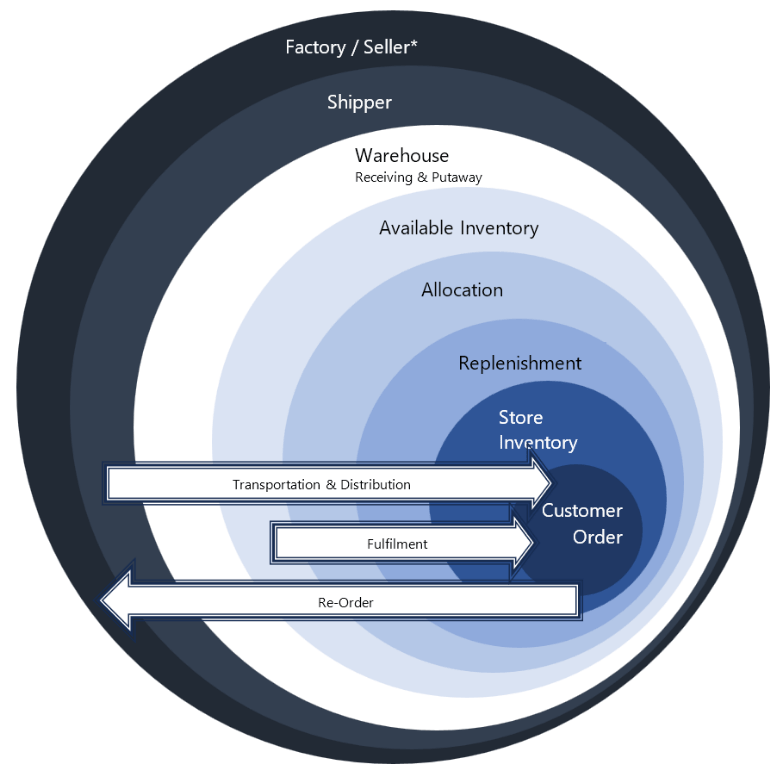
The table below outlines key functional areas, the associated data points, and how AI is applied to enhance operational efficiency.
| Inventory Layer | Key Data Points | AI Usage to Improve Efficiency |
| Factory / Seller* | • Proforma Invoice • Commercial Invoice • Packing List | • Predict lead times and invoice anomalies • Detect supply risk patterns |
| Shipper | • Advanced Shipping Notice (ASN) | • Predict shipment delays • Optimize dock scheduling at warehouse |
| Warehouse | • Putaway Status • Inventory Quantity & Location • SKU Detail • Cycle Count Accuracy • Labor Handling Time | • Predict slotting needs • Detect discrepancies • Optimize workforce allocation |
| Available Inventory | • On-hand quantity • Committed vs Free inventory • Safety stock levels | • Dynamic Available to Pick (ATP) calc • Reallocation suggestions • Overstock / stockout alerts |
| Allocation | • Demand forecasts • Store sales velocity • Promotion calendar | • Optimize first allocation • Recommend flow-through allocation |
| Replenishment | • Sell-through data • Min/max thresholds • Lead times | • Auto-trigger replenishment • Predict out-of-stock risk • Dynamic reorder points |
| Store Inventory | • Store on-hand inventory • Returns & damages • Shelf vs backroom split | • Optimize replenishment routing • Detect phantom inventory |
| Customer Order | • SKU ordered • Delivery preference • Fulfillment location | • Predict best node to fulfill (e.g., ship-from-store vs DC) • Reduce split shipments |
| Fulfillment / Distribution | • Pick time • Delivery time • On-time % • Exception logs | • Route optimization • Predict fulfillment delays • Auto rerouting |
| Reorder Loop | • Real-time sales data • Inventory velocity • Reorder frequency | • Adaptive reorder intervals • Prevent overstock / stockouts |
*Assumes FOB Incoterms
Implementing Agentic AI follows a multi-phased approach that integrates technology, business and culture. This approach can be iterative and repeated as necessary depending on the complexity and scope of the processes being automated [15].
Readiness ➡ Design ➡ Pilot ➡ Scale
Assessing readiness
Assessing readiness involves evaluating and auditing workflows, data infrastructures and IT capabilities to ensure compatibility with the agentic AI needs. These include ensuring that AI model outputs will be compatible with the organization’s future audit needs and that IT infrastructures can support the AI models data requirements.
It is also important to evaluate the company’s culture and assess the adaptability and openness to automation. This is a good opportunity to address any resistance and skill gaps through education and training to ensure that teams see the value agentic AI will add to their work.
The readiness phase is also a good opportunity to identify high-impact business use cases that can be used to pilot the implementation of agentic AI processes, and scale as necessary to the rest of the organizations, as these processes are further developed and defined.
Design
The design phase is important in defining objectives and scope, ensuring leadership buy-in and that data systems are properly integrated to meet the needs of the agentic AI models.
- Defining scope and objectives involves setting clear and measurable business goals and aligning AI initiatives with the overall company strategy. This is best achieved by identifying key business processes and applications that could provide the highest impact, show the best ROI and serve as the benchmark for future projects and applications.
- Securing leadership and cross-functional team buy-in is also critical in ensuring that AI models are fully adopted into the various business processes, and that communicated ROIs are realized to their fullest potential. This is achieved by securing sponsorship at the executive level, and assembling multi-disciplinary teams from IT, data science and engineering, operations and compliance. It is essential that clear, attainable and measurable ROIs are clearly communicated to ensure that teams work collectively towards achieving the defined goals and objectives.
- Mapping data and systems integration ensures that agentic AI systems have easy and real-time access to data across various silos including CRM, EPR and other cloud applications. This is essential in allowing agentic AI models to ingest all data required for the algorithms and produce accurate and timely outputs to guide their decisions. It is essential that close attention is paid to upgrading the security of all systems as they are integrated to ensure that no vulnerabilities are introduced as part of this process.
Pilot
Deploy the AI models in a contained environment that allows collecting live data for training. This is a great opportunity to train, fine-tune and iterate on the agents to ensure they produce accurate output, ROIs are met and compliance is achieved. Correct errors in the models and the algorithms, monitor output and behavior, and document outcomes.
Scale
Scale the phased approach across additional business functions and processes while increasing integration across the various AI agents as they are scaled. Continue to retrain agents and monitor their performance and output, paying close attention to monitoring and updating the risks and adding controls as necessary. It is also essential to continue to train and upskill employees to enable them to collaborate productively with agents.
Risks, Realities, and Responsible Scaling
Agentic AI is projected to automate up to 15% of day-to-day enterprise decisions by 2028, and potentially resolve 80% of standard customer service issues [16]. However, this also introduces a large risk surface, especially for critical systems.
- Increased cyber-attack and security risks – agentic AI systems are designed to act autonomously across multiple systems with access to various data silos across the organization. This creates a multitude of entry points and vulnerabilities for traditional cyber threats such as data leaks and hijacking. More novel and emergent threats can also be introduced such as “agent hijacking”, which allows malicious software to control agent behavior, directing it to perform unauthorized actions and access to data, and potentially collaborate with other agents through interactions that are difficult to detect and monitor.
- Loss of control & unintended outcomes – by reducing human involvement and interactions, agentic AI increases the risk for agents to make incorrect, inappropriate or harmful decisions. This is especially true for LLMs that can misinterpret data and context and lead to unintended outcomes on a potentially massive scale.
- Compliance, privacy and operational risks – agentic AI consumes and acts upon large amounts of sensitive data. Without proper oversight this opens the organization to risks of breaching privacy laws. It can also be difficult for large organizations to trace agentic AI decision making, thus making it difficult to audit, correct errors and perform disaster recovery.
In 2025, most enterprises are implementing and running agentic AI pilots, especially in functions like customer service and supply chain management. However, enterprises have yet to achieve true end-to-end adoption of agentic AI across their various business functions. To achieve this requires strong cross-functional alignment and adoption of agentic AI, something that is rare and hard to achieve.
Agentic AI has also been able to deliver value and efficiencies in domain-specific areas such as customer service and logistics, but it has yet to reliably deliver the same value for mission-critical business functions. There are still reliability challenges to overcome for agentic AI in these domain-agnostic areas.
As the market became flooded with a multitude of vendors and start-ups hoping to capitalize on the acceleration of AI technologies, the tools and frameworks offered for agentic AI have become fragmented and difficult to standardize. The pace of demand for these tools continues to far outstrip the pace at which these tools are offered.
What Kind of Retailer Will You Be?
The retail landscape is being quickly transformed by Agentic AI programs that are driving a competitive race to lead in autonomy, speed and personalized customer experiences. In 2025, retailers cannot afford not to move quickly and aggressively in implementing agentic AI in all business functions or they risk being left behind, or worse, forced to exit.
To be on track or ahead of the agentic AI trend in 2025, retailers must already be piloting or implementing it in one or more domains that were identified to have high ROI. Businesses can identify one or more functions such as customer support, supply chain and inventory management or marketing automation, where agentic AI can be strategically deployed to realize high ROIs.
IT infrastructures and systems must also be revamped through APIs and data pipelines that allow for seamless integration of AI agents across various data silos across POS, supply chain and CRM platforms. While these actions are taking place, it is critical for retailers to ensure proper governance and frameworks are put in place to manage agentic AI risks, ethics and compliance. This can be done through maintaining proper audit trails, real-time monitoring of AI agents output and decision-making, and clear disaster recovery plans.
It is also critical for retailers to ensure that employees are continuously educated, trained and upskilled in collaborating with and using AI agents. Maximizing ROIs does not rely entirely on the performance of AI agents. It also requires that employees learn and understand how to use AI agents to gain strategic insights that allow to focus on creative and impactful decisions.
Retailers can also establish agentic AI centers of excellence to ensure proper governance and compliance, manage risks and lead strategies for responsible scaling of agentic AI at the enterprise level. Training and upskilling of employees to collaborate with Agentic AI is also critical. These actions can also be further strengthened through the formation of vendor partnerships to collaborate with AI solutions providers that allow for rapid deployment capabilities and quicker realization of ROIs. Retailers can also participate is industry consortiums to benchmark, share knowledge and establish standards and risk mitigation strategies.
References
[1] https://www.walmart.com/cp/sparky/5291783
[4] https://explodingtopics.com/blog/ai-statistics
[5] https://aisera.com/blog/agentic-ai/
[6] https://www.salesforce.com/agentforce/what-is-agentic-ai/
[7] https://www.fluid.ai/blog/why-agentic-ai-will-replace-traditional-businesses-by-2025
[8] https://beam.ai/agentic-insights/what-is-agentic-ai-why-every-entrepreneur-should-care-in-2025
[9] https://aisera.com/blog/what-are-ai-agents
[11] https://useinsider.com/agentic-ai-marketing/
[12] https://www.mckinsey.com/capabilities/quantumblack/our-insights/seizing-the-agentic-ai-advantage
[14] https://www.willowtreeapps.com/insights/quantifying-opportunity-value-of-agentic-ai
[15] https://customerthink.com/designing-intelligent-cx-a-practical-roadmap-for-agentic-ai-deployment/
[16] https://www.riskinsight-wavestone.com/en/2025/07/agentic-ai-typology-of-risks-and-security-measures/