
Transformative Discovery: Integrating Coaching Principles for Project Success

The Human-Centered Approach to Discovery

At the core of effective discovery work lies the importance of coaching when gathering requirements. Over time, I’ve realized that meaningful insights rarely emerge from rigid templates or formal interviews; instead, they arise through genuine conversations where people feel supported enough to pause, think deeply, and express what they need.

Often, an initial request such as “We need a dashboard,” or “Can you shorten this workflow?” uncovers more fundamental issues like decision-making, team alignment, confidence, or communication barriers. By approaching discovery with a coaching mindset, we can reveal these underlying concerns rather than just addressing superficial symptoms. If you’ve ever experienced a discovery session that seemed more like coaching than interviewing, you’ll recognize the value of intentionally cultivating this dynamic.

Reflecting on my recent years of interviews, I’ve noticed a shift, they increasingly resemble coaching sessions. Initially, I thought I was merely “collecting requirements,” but over time, it became clear I was guiding people in clarifying their actual needs. Rather than just recording their requests, I was facilitating their thinking.

In early design meetings, users typically begin with basic asks: “We want a dashboard,” “Can you make this workflow shorter,” “Can we have a button that does X?” These are useful starting points, but they seldom tell the whole story. When I consciously adopt a coaching approach, slowing down, listening attentively, and posing thoughtful questions, the dialogue changes dramatically. At that moment, our focus shifts beyond the user interface into deeper topics: friction, decision-making processes, confidence, accountability, ambiguity, and the human elements hidden beneath feature requests.

Many professionals who have spent decades in their roles rarely get the chance to reflect on the patterns shaping their daily work. So, when I ask something as straightforward as, “What’s the hardest part about planning next season?” the answer often reveals gaps and bottlenecks behind the scenes, rather than issues with the software itself. These stories simply don’t surface during standard meetings.

Uncovering Deeper Insights through Curiosity and Coaching

Curiosity allows us to explore areas untouched by process charts and requirement documents. Prioritizing the individual over the process exposes context that’s invisible on paper, like emotional burden, workplace politics, quiet worries, workarounds, and shared tribal knowledge. Coaching fosters an environment where all these factors come to light, transforming them into valuable material for design decisions.

I used to think the better I got at systems, the less I’d need to do this. But it turned out the opposite is true. The better the system, the more human the conversations become. Coaching is almost like a bridge, helping people cross from “I think I need this feature” to “Here’s what I’m actually trying to solve.”

Active Listening and Guided Curiosity

Active listening forms the core of my approach, ensuring I deeply understand not just participants’ words but the meaning behind them. I reflect statements back — such as, “So it sounds like the challenge isn’t entering the data, it’s aligning on which data to trust, right?” — to confirm genuine understanding. This often transforms technical discussions into conversations about alignment, ownership, or governance.

A key tool is the “Five Whys” technique, which I use as a guide for curiosity rather than a rigid checklist. If someone requests better notifications, I’ll probe: “Why is that important?” and follow with questions like, “Why is it hard to notice things right now?” or, “What happens when you miss something?” By the fourth or fifth ‘why,’ the conversation surfaces underlying factors such as workload, confidence, or fear of missing out, revealing emotional and operational triggers beneath the initial request.

In workplaces, these deeper issues often connect to organizational culture. For example, a request for faster workflows sometimes indicates a real need for predictability or reduced chaos, rooted in communication or authority structures rather than the system itself. Recognizing these patterns enables more effective design decisions by addressing root causes instead of just symptoms.

Intentional silence is another valuable technique. After asking a question, I resist filling the pause, giving participants space to think and speak freely. This silence often prompts unfiltered insights, especially when someone is on the verge of articulating something new. Allowing this space helps participants trust and own their insights, leading to more meaningful outcomes.

Future-Focused Exploration and Empowering Language

I also employ future-anchoring questions like, “Imagine it’s six months after launch — what does success look like for you?” or, “If the system made your job easier in one specific way, what would that be?” These help participants shift from immediate concerns to aspirational thinking, revealing priorities such as autonomy or coordination that guide design principles.

Tone and language are critical for psychological safety. I aim to make discovery feel inviting, often assuring participants, “There’s no wrong answer here,” or encouraging them to think out loud. When people use absolutes — “We always have to redo this,” “No one ever gives us the right information” — it signals where they feel stuck. I gently challenge these constraints by asking, “What might need to change for that to be different?” This opens possibilities and helps distinguish between real and internalized limitations. Coaching-based discovery is key to uncovering and addressing these constraints for lasting change.

Reflections and Takeaways

Coaching Tools as Foundational Practice

Initially, I viewed coaching tools as separate from implementation work, and more of an optional soft skill than a crucial element. Over time, my outlook changed: I saw these tools as fundamental to successful outcomes. I noticed that the best results happened when participants truly took ownership of the insights we discovered together. That sense of ownership was strongest when the understanding came from them, even with my guidance. Insights gained this way tend to last longer and have a greater impact.

My approach to discovery has evolved significantly over time. Initially, I viewed discovery as a process focused on extracting insights from users. More recently, it has transitioned into facilitating users’ own self-discovery, enabling them to articulate intuitions and knowledge that may have previously been unexpressed. This progression from a transactional checklist to a collaborative and transformative meaning-making practice has had a substantial impact on my design methodology.

Efficiency through Early Alignment and Clarity

Contrary to prevailing assumptions, coaching-based discovery does not impede project timelines. Although it demands greater initial investment of time, the resulting enhanced alignment and mutual understanding often expedite progress. Early engagement in substantive discussions enables teams to minimize rework, clarify decision-making processes, and avoid misinterpretations, which can ultimately result in projects being completed ahead of schedule due to unified objectives.

Efficiency is driven by clarity. When users feel acknowledged and their perspectives are incorporated, their level of engagement and willingness to collaborate increases. The trust established during these interactions persists throughout testing, feedback, and rollout stages, mitigating many subsequent problems that typically occur when user requirements are not considered from the outset.

Strong Implementation Questions Are Strong Coaching Questions

At their core, effective implementation questions are essentially strong coaching questions. These are fuelled by curiosity, maintain a non-judgmental tone, and aim to empower others. Instead of guiding someone toward a set answer, such questions encourage individuals to uncover their own insights about the work.

Regardless of the type of discovery — be it design, implementation, or workflow — insight comes from those directly involved. Coaching goes beyond mere technique; it represents a mindset based on the belief that people already hold valuable wisdom. The coach’s job is to help draw out this knowledge, using thoughtful questions.

A key moment in coaching-based discovery happens when someone has a sudden realization, saying things like, “I’ve never thought about it that way,” or “Now I understand why this keeps happening.” These moments are where improvements in design and implementation begin.

Such realizations act as anchors throughout a project. When team members shift their understanding, these breakthroughs can be revisited during times of complexity or tough decisions, providing direction as a “north star” to keep teams aligned.

Coaching is not just a resource, it should be demonstrated in everyday interactions. As teams experience its benefits, they often adopt coaching practices with each other, leading to genuine transformation that extends past individual projects and influences wider workplace culture.

Ultimately, the real value of this work lies not just in the solutions themselves, but in the conversations that reshape how people engage with their work.

Learning to Lead in the Wilderness

There is value in nurturing and growing the qualities of leadership within all of us. As leaders, we improve our lives and the lives of others arounds us. We develop the skills and capabilities that allow us to rally others around common goals and to show them the path forward . In the process, we help advance humanity through peaceful collaboration and existence. 

Introduction

On an early winter morning in 1996, I heard a loud knock on my dorm room door. It was 2 a.m., and as I was waking up, I could gather some of the words spoken loudly by my wilderness instructor, Tom Lamberth, from behind the door.

Good morning Baha, there is a missing skier, and we have been called to assist in the search. We leave in 40 minutes.”

That’s all Tom said as he continued his rush down the hallway to wake up the rest of the team members in their rooms. Tom was the wilderness instructor during my time at the United World College of the American West (UWC USA) in New Mexico. The reason he was knocking on my door early that morning, I was a team leader in the wilderness program.

Search and rescue was part of the community service requirements for the International Baccalaureate curriculum. The previous year I had spent training to be a leader of a search and rescue team. I learned the expected survival and navigation skills, first-aid and most importantly, how to care for the members that made up my team.  It was through this experience, where I was introduced to what it meant to be a leader and the responsibilities that it carries.

As I led my classmates through the snowy night, deep in a New Mexico mountainous forest, I understood the value of trust. I felt a sense of pride that we trusted each other, and they trusted me, to guide us through the difficult terrain.

My experience at the college, and particularly my experience as a team leader and the sense of pride I felt when I had earned the trust of my team members, has shaped how I show up in my work. The last few weeks I have been reading about and contemplating what it means to be a leader and how I have shown up as a leader during my career.  I have been considering what qualities have defined my leadership style to date, alongside those that I look to hone and practice, to grow with intention and authenticity. What follows are the thoughts I have been thinking about.

The qualities of leadership

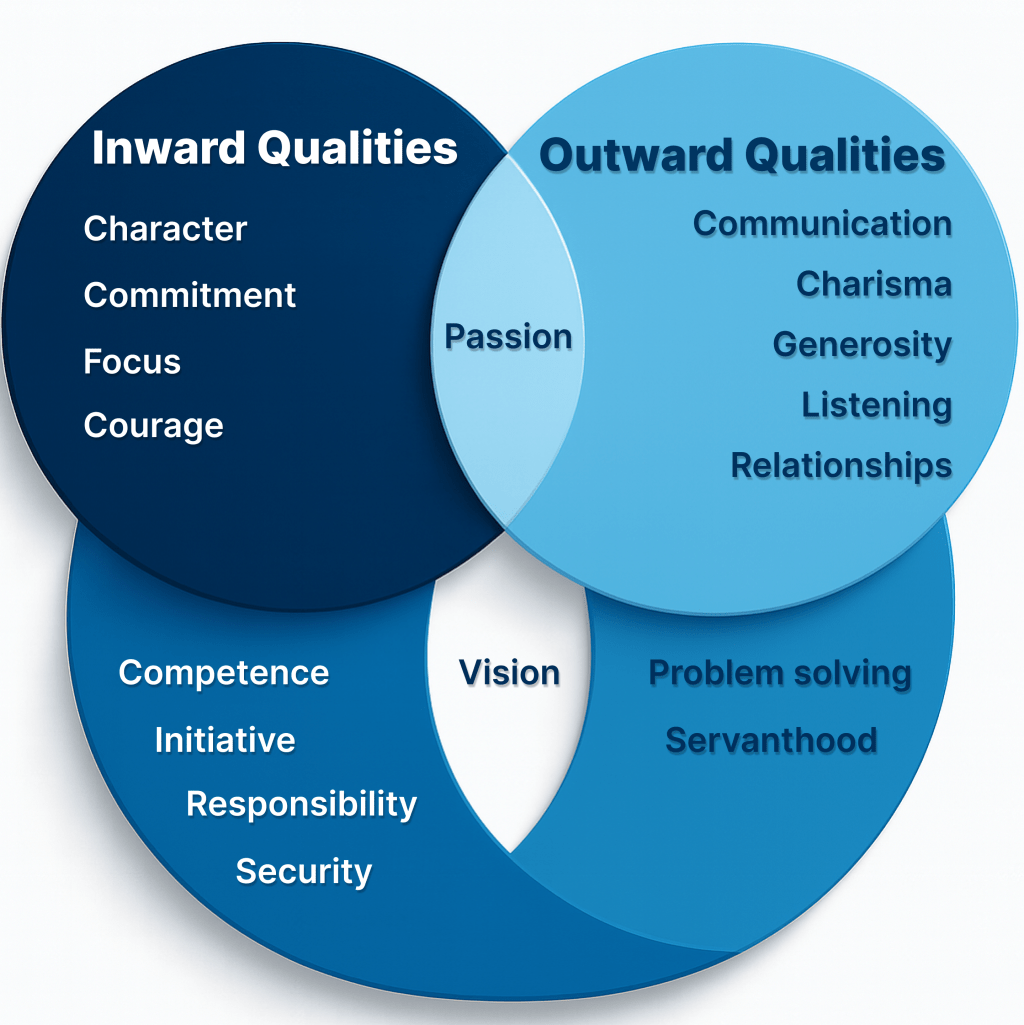
When a person embodies the true qualities of a leader, no matter what their age, social context or qualifications are, they can rally people around them towards a common purpose. Leadership qualities can be inward or outward facing, but regardless of how they are expressed in an individual, we are always drawn to them for their ability to embody those qualities in a way that gives meaningful expression for our own ideas and causes.

Inward qualities of leadership

The inward qualities of a leader are not always immediately visible to us, however they are powerful in creating that invisible pull we feel towards them. The following are key inward qualities of leadership.

Character – a leader’s character inspires confidence in people to rally around them. A leader’s character embodies their thoughts, feelings and behaviours and it drives the actions behind their words. Their character is based on strength and integrity, and it is something that they constantly build on and improve. People will not follow a leader if they do not have trust in the strength of their character.

Commitment – no one is drawn to an uncommitted leader. Commitment separates dreamers from doers, and nothing is more powerful than someone who is committed to their goal, their cause or their quest. We may not always be motivated to pursue our goals, or we may be in a state where we cannot quite find the way forward. A committed leader, especially one whose goals and dreams align with ours, can be the catalyst that allows us to rally around them towards achieving those goals and dreams.

Focus – a leader combines their priorities with concentration on achieving those priorities. They focus mainly on their strengths and doing the things they can do best, but they also focus on improving their abilities in new areas because they constantly seek change and improvement.

Passion – passion is the true driver of success. There is no doubt that most successful entrepreneurs and leaders achieve their success not through training and education, but through true love and passion for what they do. A strong desire to bring their ideas to life is what allows leaders to achieve their goals and dreams. Passion drives unshakable willpower and makes what seems impossible, possible. This is why passionate leaders are so effective, they believe in the ideas, goals and dreams they envision, and they pursue them with unwavering commitment.

Other inward leadership qualities include and not limited to competence, courage, initiative, responsibility, and security. They are all intertwined with the qualities highlighted above, strengthening them and reinforcing their foundations. 

Outward qualities of leadership

Outward leadership qualities are easily noticed and they capture our attention in a leader. When we see how a leader communicates, listens and cares for others, we easily connect with them, especially if their goals and ideas match ours. Below are the key outward qualities of a leader.

Communication – clarity, speaking their truth, recognizing others and seeking their thoughts are the cornerstones of communication. A leader speaks their message with absolute clarity and out of pure and uncompromising conviction. They have an unshakable belief in the truth behind what they say. They also actively solicit feedback from their audience to help them adjust and validate their message.

Charisma – charismatic leaders can attract others to them by focusing on the best in the people around them. They focus on making sure that every person they interact with receives their full attention, and that they are the most important person in the room, not the other way around. By listening to others and recognizing their ideas and needs, leaders cultivate a sense of a shared common cause that further strengthens their leadership.

Generosity – leaders do not gather just for themselves. They share their successes and wins with others. A leader’s generosity is embodied in their gratitude and appreciation for what they have, by putting others first, and most importantly by putting their resources and money to work in the service of others. Gratitude cultivates a habit of giving generously, and this tends to come back through a multitude of rewards both material and otherwise. When this attitude is inherent in a leader, there is no limit to the positive impact they can have on others.    

Listening – a leader earns trust and connection before they ask to be followed. The only way to build trust and connection is by truly listening first. For a leader, this means listening while wholeheartedly embracing the diversity of the voices and opinions they hear. A leader can learn nothing by simply speaking their own opinions. The only way they can learn is by listening to and learning from the thoughts and opinions of other people. 

Relationships – we do not tend to maintain relationships with people who do not care for us. This is even more true for people we want to follow. Leaders understand people, not in the general sense, instead they get to know every person they interact with. True leaders are centered in their purpose to help others.

Other outward qualities of a leader include vision, problem solving, and servanthood.

The qualities of leadership

Final remarks

When I think back on my time at UWC USA, I realize how much Tom embodied the qualities of leadership I highlighted above, and how much I learned from him. I watched Tom and listened to him closely as he trained and prepared us for survival in the wilderness. That experience continues to define how I view my life and my work.

As a father, guiding my children towards their future means that I serve as an example to them by showing commitment and passion to the work I do, and ensuring that I communicate, listen and always place them and their needs at the center of my attention. I have also always applied the same practice to my work and how I interact with my colleagues. Without fail, I found that this practice has allowed to me be a better father, a more supportive and productive colleague, and overall a better person.

There is value in nurturing and growing the qualities of leadership within all of us. As leaders, we improve our lives and the lives of others arounds us. We develop the skills and capabilities that allow us to rally others around common goals and to show them the path forward . In the process, we help advance humanity through peaceful collaboration and existence.


If this story resonates with you, or if you simply want to chat about your own experiences and how leadership has helped you or can help you in your work, I’d love to connect.

Feel free to reach out through LinkedIn or contact me here. Let’s explore how thoughtful, human-centered design can transform your next project

The Power of Optimism in Design: Lessons from Sales and Personal Experience

When we are optimistic, we strive to bting out the best in us and create our best work. An optimistic attitude allows us to be bold and even adventurous with our ideas, and we start to create out of inspiration and confidence in the true potential of our work.

Introduction

In his book Learned Optimism Martin Seligman describes a study in 1985 that focused on fifteen thousand insurance agent applicants to Met Life [1]. The study involved one thousand of the fifteen thousand applicants who failed the standard industry test, but who took an additional test called the ASQ that determined whether they were optimists or pessimists. The higher the ASQ score the more optimistic an agent was determined to be. The goal of the study was to hire these agents as part of Met Life’s workforce and measure the performance of optimistic agents compared to the pessimistic ones.

The study showed that agents in the top half of the ASQ score sold 20% more insurance than the less optimistic ones from the bottom half. Agents from the top quarter of the ASQ sold 50% more insurance than those from the bottom quarter. The study predicted that optimism determined which of the agents survived and sold the most insurance, and it did so about as well as the industry test. Seligman’s study clearly shows the impact of optimism on the success of insurance agents selling insurance, and it enabled Met Life to change their hiring practices to not focus only on whether agents passed the industry test, but also on how optimistic they were.

How does Seligman’s study apply to design? Designers, like insurance agents, are also sales people. They sell ideas, stories and concepts that shape products to a different group of people. While insurance is a discretionary product that consumers can choose not to buy, designers sell key ideas that shape the way business organizations operate, the way they serve their customers and that ultimately shape the business bottom line. In a way, the challenges designers face in their task of selling their design ideas can be just as challenging, if not more challenging, than that of insurance agents. That’s because designers must sell ideas for products that must work and achieve the business and organizational success they set out to achieve. In this case, “not buying” the product is not an option for the organization, and the product and the ideas behind it must succeed.

Why optimism is essential for a designer

A designer’s role is not limited to only being able to tell compelling stories about the design solutions they propose. They need to effectively sell the ideas built into those stories to business stakeholders, who can often be at different levels of seniority and receptiveness. If we were to rely on the results of the study by Seligman as a guide, then optimism and a positive mindset play a key role in enabling a designer to achieve their objectives.

An optimistic mindset is essential to the designer’s success and the success of their team. Every organization has a different culture and level of receptiveness to change, especially when it comes to digital products that reimagine existing business processes. The designer may be working with a business team that is used to following a decades old business processs and they may be resistant to changing it. A successful designer can place themselves in any type of business environment, adapt to the existing culture and learn to work within its confines.

The key is to maintain a positive and optimistic attitude towards the outcomes of the project, the stakeholders and the team the designer works with. This attitude communicates the designer’s confidence in their ability to succeed in their work by demonstrating to everyone around them, that they believe in the value their work and design will bring.

How optimism helped me in my career

On a past project where I led the design for an options trading application at a financial institution, I witnessed the importance of an optimistic mindset firsthand during a design review I was leading. The application I was working on was a highly specialized investing application, and I was working with a team of stakeholders who were extremely specialized in their line of business and had strong beliefs about how the application should behave. The stakeholders believed, and rightly so, that they had a strong understanding of their customers and how they tended to use the application. When I started work on the application, I relied on user research, personas and journeys as well as extensive competitive analysis and frequent peer reviews to propose my designs. During one of the design reviews, as I was reviewing a flow in the design I was proposing, one of the stakeholders in a corner of the room interjected and said:

“I am not sure why we should take his (referring to me) advice on how this should work. We can do a far better and more efficient job at it if we design and implemented it ourselves.”

This comment could have demotivated me and discouraged me from continuing with my review. I could have viewed it as a failure rather than feedback. However, I remember not being phased by it because I was confident in the value of my design and I needed to show that to the stakeholders. Instead of taking that comment and allowing it to impact me negatively, I acknowledged the feedback and I repeated my explanation of the design. I backed up my explanation by invoking the research, the competitive analysis, best practices and peer reviews that led me to the proposed design. Reframing this experience and seeing the positive in it fueled my confidence that I would be able to get buy-in from all stakeholders including the one who offered the feedback. I was able to show them the value in the design I was proposing by acknowledging their feedback and showing my confidence in the design I was proposing through evidence and research.

There was another occasion in my career where I realized the value of having an optimistic mindset. On that occasion, I found that my design was well received by the stakeholders after several design reviews and iterations. However, one day as I was reviewing my design with my manager, I realized he did not have a good opinion of it. This was not uncommon, because a good designer should always operate from a perspective that no design is prefect and that there is always room to improve. However, what was uncommon was the way this feedback was delivered:   

“I understand this design has been approved by the stakeholders, but I don’t like it. It may too late to change it now, but I will make sure to change it in the next product iteration.”

In other words, instead of his feedback being constructive and offering ideas on how to improve the design, it was dismissive and only offered the option of him taking over the design and changing it himself. This could have been another instance where it was easy to feel a sense of failure after all the work and effort I invested in obtaining the stakeholders’ buy-in. Instead, I worked with my manager to understand where he thought the gaps were, took his feedback and incorporated it in the design. I took leadership and ownership of this situation and worked with the project manager to allow me to regroup with the stakeholders, and I was able to successfully obtain their buy-in on the updates.

These experiences, along with many other experiences I had over my career, taught me the power of optimism and a positive mindset. On both of the occasions I mentioned above, I was successful in moving the design toward production with great feedback from end users. I did not give up and maintained confidence in my abilities and my design ideas, and I was able to approach my work from a perspective that was geared towards and focused on success. Everyone I worked with also wanted to invest in my success because it also meant they were also investing in their own success. When a designer adopts an attitude of optimism they quickly notice that everyone they work with also adopts the same attitude. There is no doubt that an optimistic attitude paves the way to overcoming the  challenges and obstacles faced in the design process, even if that took time and effort to achieve.

How a designer can adopt an optimistic mindset

The practice of cultivating optimism is grounded in Psychology. When practiced by the designer, these principles can bring tremendous benefits to their work. Below are the most important principles that can be practiced to cultivate optimism:

Cognitive reframing – Mistakes can happen. Important requirements may be missed or misunderstood. Other times, design decisions are made but no close attention is paid to them until much later in the design stage, and they must be changed. Instead of the designer blaming themselves for mistakes, it is more useful to reframe the mistake, turn it into a learning experience and find a way to pivot.

Gratitude practice – For a designer this means observing and focusing on the occasions when their work makes a positive impact. For example, not everyone may agree with their design direction, and they may often face criticism on what designs should look like. Focusing on the positive aspects and how their design is making a difference to the stakeholders and end users, and appreciating the impact it is making, can inspire the designer to take the feedback received and further improve on their work.  

Visualizing positive outcomes – Visualizing best case scenarios helps create a sense of possibility and cultivates an attitude that anything can be achieved. A designer should focus on the possibilities a design solution can create and operate from a mindset that their design solution will bring the value that is expected.

Surrounding oneself with optimism – Our environment is important in reinforcing how we behave and react. When we surround ourselves with positivity, positive outcomes will come to us. This practice goes beyond the workplace and applies to everything we do in life. If a designer is constantly seeking a positive environment, then that will ultimately reflect in their attitude and how they come across to others they work with. The designer will notice that everyone they work with becomes more receptive to their ideas, and more willing to work with them to develop those ideas and share in their success.

Setting small, achievable goals – Progress fuels optimism, and small wins help us feel capable. When design problems seem difficult or consensus seems out of reach, it is important to set small and achievable milestones, and celebrate when those milestones are achieved.

Practicing self-compassion – We are always our own harshest critics. Speaking to ourselves with compassion and encouragement, not blame, helps us find the positive in our work and move forward with solutions that will allow us to achieve our goals.

Adopting an ‘Experimental’ mindset – This practice is the most important one in cultivating an optimistic mindset. If something does not work, it should be considered as feedback to improve and not a failure. It is all too often that designers experience setbacks where design may not meet expectations. Sometimes business stakeholders or managers may disagree with the designer’s approach. A designer might react to this thinking “I did not do a good job on this design” or “I failed to understand the requirements”. Reframing this as “I can propose different design alternatives” or “I can show how my design improves on the requirements” makes the setback feel less threatening.

Conclusion

Seligman’s study showed that optimism could predict success, above and beyond traditional criteria for hiring insurance agents. The results of the study were so effective that Met Life and other industry players changed their hiring practices to hire agents who scored high on the optimism test yet narrowly failed the industry test. Like this study in insurance sales, the success of a designer in his work also hinges on optimism and a positive attitude. It is possible for a designer to follow and implement the best practices and theory of design, but if they cannot maintain an optimistic and positive attitude they will struggle to achieve a successful outcome. When we are optimistic, we strive to bting out the best in us and create our best work. An optimistic attitude allows us to be bold and even adventurous with our ideas, and we start to create out of inspiration and confidence in the true potential of our work. Optimism empowers a designer to focus on the success of their design ideas rather than the failures, turn setbacks into opportunities and adopt a mindset where everything is achievable even when faced with complex problems.   

References

[1] Seligman, M. E. P. (2006). Learned optimism: How to change your mind and your life (2nd ed.). Vintage Books.

Designing with Empathy: A Universal Practice for Meaningful Collaboration

In an era marked by the rapid advancement of artificial intelligence, it is reassuring to recognize that the human capacity for empathy remains unique and irreplaceable.

Introduction

On a recent project I worked on I found that I was not very clear on the subject matter and the complexity of the problems that were presented. I did not know any of the business stakeholders well, and while I had previously worked with some of the project team members, I had not yet developed a meaningful working relationship with them. I needed to get up to speed quickly so that I could start thinking about how to run discovery sessions, and how to frame the problem and ask the right questions in my stakeholder interviews.

To arrive at that stage I needed to get to know the stakeholders, understand what was important to them and what motivated them to embark on this project. To accomplish this, I spent time both privately and in group discussions with the stakeholders. The one-on-one interviews I initially conducted with the stakeholders and the group discovery workshops were helpful in allowing them get to know me as a person first, before being the individual filling the role of the designer on the project.

I was able to gain the stakeholders’ trust by showing that my role was first and foremost focused on understanding their needs and goals, and that I was immersing myself in their experiences. This was essential for the stakeholders because they were trusting me to lead the design on a project that impacted their day-to-day work, and it was also essential for me to help establish a strong foundation and build trust as I embarked on this project.

When I reflect on how I was able to arrive at that stage of trust and partnership with the stakeholders, I realize that it was the fact that I understood and related to how they felt about their work, and that I tried to put myself in their shoes by rephrasing and reconfirming my understanding of their problems. I was successful in letting the stakeholders know that that they were not alone in the challenges they were facing, and that I was there to understand the problems they were trying to solve by really imagining myself as part of their team. I wanted to show that I could relate to them so that together we could start a journey to gain a better perspective and create a great solution.

This example is only one of many I can reflect on throughout my career as a designer, where I realized the fundamental role empathy plays in providing reassurance to myself and others I worked with, that we all shared a mutual care and understanding of our experiences and goals.

In this post, I explore the need for designers to consistently practice empathy throughout all aspects of their role. For designers, empathy extends beyond end users, encompassing every individual involved in the design process, including stakeholders and colleagues. I refer to this as Universal Empathy, wherein a designer is expected to genuinely understand and relate to everyone within their professional sphere to effectively create products that are usable, impactful, and successful.

Why Empathy Matters In Design

In psychology, empathy is defined as the capacity to comprehend and share the feelings of another individual. This extends beyond courteous or considerate behavior, involving the ability to perceive situations from another person’s perspective, understand their emotions, and respond appropriately in alignment with their perspective. Such an understanding allows individuals to convey genuine support, assuring others that their experiences are acknowledged and their needs are recognized.

Tim Brown identifies empathy as a fundamental element in design thinking, particularly when addressing complex problems [1]. As a human-centered methodology, design thinking requires a comprehensive understanding of users’ needs, business requirements, and relevant organizational and technological considerations to achieve successful product development.

Kouprie and Visser [2] provide an in-depth examination of the role of empathy in design by presenting a four-phase model. They describe how designers should adopt a dynamic, multi-stage approach to empathy that includes the following phases:

  • Discovery: In this phase, designers remain inquisitive, actively observing, learning, and asking questions about users.
  • Immersion: This phase involves designers engaging directly in the user experience through interviews, observation sessions, and shadowing activities.
  • Connection: At this stage, designers identify with users and establish a genuine understanding of their feelings regarding their experiences.
  • Detachment: Finally, designers apply their insights objectively, ensuring that design decisions are informed by the observations gathered during earlier stages.

The work by Kouprie and Visser further underscores the designer’s essential role in acting as a catalyst for the phases of empathy. This helps foster the creation of effective solutions that serve both end user and organizational goals.

Universal Empathy

I would like to emphasize how the designer’s universal approach to empathy is essential to their success, the success of their team, and ultimately the success of the products they design. This approach is essential throughout the product design lifecycle, beginning with the design thinking phase and through to the development and implementation phase. Designers play a pivotal role, not only in guiding design discovery and generating research-driven concepts, but also in fostering team cohesion and promoting a collaborative culture rooted in empathy. The designer accomplishes this by bridging the gap between the user needs, stakeholder needs and the project team needs by fostering a comprehensive understanding of the goals of everyone involved in the project.

The designer cultivates universal empathy by:

  • Listening to, understanding and connecting with user needs, connecting with their experiences and knowing when to disconnect in order to be able to make objective design decisions.
  • Building trust with stakeholders and connecting with their needs and establishing a strong foundation to collaborate on building a product that meets the needs of both the business and the end users.
  • Facilitating their team’s understanding of technical design aspects by readily addressing questions, remaining attentive to the team’s needs, and helping when required.
  • Fostering an overall inclusive environment that recognizes and values feedback from everyone in their sphere, promotes successful collaboration and addresses the diverse requirements and viewpoints involved in the design process.

Conclusion

I have consistently found that demonstrating empathy toward those around me has contributed significantly to my success in my work and my career. By cultivating this approach, I learned to listen, understand, acknowledge and fully immerse myself in the experiences and feedback from users, business stakeholders, and my colleagues alike.

I have also been able to help to foster a culture in which individuals support one another and feel comfortable seeking assistance when needed. In my experience, such an environment always promoted greater job satisfaction, personal growth and stronger professional relationships that extended beyond individual tasks and contributed towards shared goals.

In an era marked by the rapid advancement of artificial intelligence, it is reassuring to recognize that the human capacity for empathy remains unique and irreplaceable.

References

[1] Brown, T. (2009). Change by Design: How Design Thinking Creates New Alternatives for Business and Society. Harvard Business Press.

[2] Kouprie, M., & Visser, F. S. (2009). A framework for empathy in design: Stepping into and out of the user’s life. Journal of Engineering Design, 20(5), 437–448.