The Quantum Realm: Our Connection to the Universe

At the quantum scale, the universe manifests as a field of infinite possibilities, where the electrons within our atoms move in clouds of probability, always shifting. Consequently, we, as humans composed of countless atoms, are an inseparable part of the universe’s ever-changing nature, and our problems, at the quantum level, do not really exist.

Introduction 

When we close our eyes and place our hand on our forehead, we perceive the firmness of our hand and the gentle warmth of our skin. This physical sensation, the apparent solidity and presence of our body, seems tangible and reassuring. However, at the most fundamental level, our bodies are composed almost entirely of empty space. Beneath the surface of our bones, tissues, and cells, we find that our physical form is constructed from atoms, which themselves are predominantly made up of empty space, held together by the invisible forces of electromagnetism. The idea that we are, in essence, built from empty space can feel unsettling, yet it is central to our understanding of quantum mechanics.   

If we imagine an atom, and picture a single proton as a grain of sand placed at the centre of a football stadium, the nearest electron would be found somewhere in the outer bleachers, approximately 90 metres away. The vast expanse between the proton and the electron is filled with nothing but empty space [1]. The electrons themselves do not orbit the nucleus like tiny marbles following a fixed path. Instead, they ripple through space in a cloud-like manner, appearing in one location at one moment, and in another the next. Their movement is not governed by certainty, but by the probability clouds that define their position and momentum.    

The Universe Is Impermanent

Everything in the universe is in a state of constant motion. Objects such as chairs and tables may appear completely motionless to our eyes, yet at the quantum level, this sense of stillness is an illusion. Even as we sleep and perceive ourselves to be at rest, the atoms that make up our bodies are ceaselessly moving and vibrating. This underlying activity is dictated by the principles of quantum mechanics, which reveal an intricate and dynamic world beneath the surface of everyday experience.

Werner Heisenberg’s uncertainty principle states that it is impossible to simultaneously know both the precise position and the exact momentum of any object [2]. The more accurately we measure one, the less certain we become of the other. This fundamental limit means that no object can ever be fixed in a single, definite spot while remaining absolutely still. To do so would violate the laws of quantum physics, which require all matter to retain a degree of movement and uncertainty 

Consider a ball placed in a bowl and cooled until it appears perfectly still at the bottom. According to the uncertainty principle, the ball can never truly be at rest. It will always exhibit a subtle vibration, as restricting its position too precisely leads to uncertainty in its momentum. This perpetual motion is known as the ball’s zero-point energy.  

A universe where everything is perfectly still would not permit life as we know it. Nothing in the cosmos is permanent; particles continuously move, shift, and even appear and disappear. Remarkably, quantum theory predicts that even the vacuum of space is not empty but is filled with modes of vibration possessing zero-point energy [3]. This means that space itself is permeated by an endless and restless sea of energy, where particles are constantly popping in and out of existence, reflecting the ever-changing nature of reality.  

Quantum Mechanics and the Foundations of Consciousness 

At the quantum level, the behaviour of particles is defined by several extraordinary phenomena, including superposition, entanglement, coherence, and the observer effect. In the phenomenon known as superposition, particles can exist in multiple states at the same time. These particles remain in superposition until an act of observation occurs, causing their wave functions to collapse into a single, definite outcome. When two particles interact and become entangled, their properties, such as spin, polarization, and momentum, become fundamentally inseparable. Measurement of one entangled particle instantly determines the state of its partner, regardless of the distance separating them. 

Humans are deeply entangled with the inner workings of the universe. Our thoughts, memories, and emotions are rooted in the quantum behaviours of the atoms that compose our bodies. Consciousness, in this context, is shaped and defined through quantum operations. The billions of neurons firing simultaneously in the human brain function through quantum entanglement, collectively giving rise to our conscious experience [4]

Stuart Hameroff and Roger Penrose, in their 1996 paper, argued that consciousness depends on coherent quantum processes within collections of microtubules found in brain neurons. At the lowest neurophysiological level, the cytoskeleton of neurons in the human brain is composed of protein networks, specifically neurofilaments and microtubuli. These structures are essential for various transport processes within neurons [5] [6]. According to Hameroff and Penrose’s theoretical framework, tubulins in microtubuli serve as the substrate for quantum processes. 

Through their Orchestrated Objective Reduction (Orch OR) theory, Hameroff and Penrose proposed that the brain’s microtubules act as quantum computers, maintaining coherent quantum states that collapse in a process tied to the geometry of space-time and influenced by quantum gravity. In this framework, consciousness operates as a quantum wave function passing through the brain’s microtubuli, with these collapses corresponding to the observer’s elementary acts of consciousness and embedding them directly into the fabric of the universe. 

Conclusion 

Contemplating the foundations of our bodies and consciousness, it becomes apparent that quantum mechanics may govern much more than just the biological processes within us. While the Orch OR theory proposed by Hameroff and Penrose remains a topic of debate, it opens the door to the possibility that consciousness arises not solely from biological functions but also from quantum phenomena.

In quantum computing, the act of observation is inherently influential, determining the state to which a particle’s wave function collapses. This raises a profound question: could quantum mechanics provide an explanation for our ability to perceive and realize different realities within our consciousness? Furthermore, could our observation of quantum states, which shape our consciousness, be the very mechanism that connects us to the universe in a holistic manner?

I found that for me, the most meaningful way to think about it was that the concept of uncertainty and constant motion is central to how the universe operates at the quantum level. If our bodies and consciousness are subject to the laws of quantum physics, then our experiences of periods of darkness and despair, feelings of being stuck or hopeless, are never truly fixed states. Motion persists within our atoms and within our consciousness, regardless of our perceptions. The pressure we experience, the everyday stresses, and our emotions are all shaped by how we observe and interpret events. At the quantum level, nothing remains permanent; everything is in flux.

This perspective is not meant to diminish our existence as human beings. Rather, it highlights our intrinsic connection to the fabric of the universe. The universe does not operate with absolute certainty or permanence; it is defined by uncertainty, continual change, and movement. At the quantum scale, the universe manifests as a field of infinite possibilities, where the electrons within our atoms move in clouds of probability, always shifting. Consequently, we, as humans composed of countless atoms, are an inseparable part of the universe’s ever-changing nature, and our problems, at the quantum level, do not really exist.


Designing solutions that effectively meet user needs is the driving force behind my work. I also share practical insights on computing and human-centered design each week. I’d love to connect and discuss your design ideas or challenges; feel free to reach out to me today on LinkedIn or contact me at Mimico Design House.

Bringing Ideas to Life: My Journey as a Product Architect

My work is about helping clients and organizations bring their ideas to life, transforming understanding into development, and development into reality, with as little friction and as much functionality as possible.

Lately, I have been reflecting on what drew me, as a designer, to write about topics such as artificial intelligence and quantum computing. I have been fascinated with both topics and how they have transformed that way we view the world. Everything we see today in terms of advancements in AI and quantum computing started with an idea, brought to life through innovation and perseverance.

In AI, there was the idea that machine learning would transform the way we do business by leveraging large amounts of data to provide valuable insights, something that would not be easily attainable through human effort. In quantum computing, there was the idea that applying the way particles behave in the universe to computing would unlock a vast potential for computing capabilities and power, beyond what classical computers can achieve. So many other advancements and achievements in AI and quantum computing continue to be realized through the conception of ideas and the relentless pursuit of ways and methods to implement them.

Everything starts with an idea

Beyond AI and quantum computing, everything we see around us started with an idea, brought to life through continued and persistent effort to make it a reality. Every building we see, every product, every service and all material and immaterial things in our lives are the product of an idea.

As a designer and product architect, I also help make ideas a reality through persistent effort and the application of methodology that lays a roadmap for the implementation of those ideas. Similarly, AI and quantum computing are fields that are bringing novel and exciting concepts to life through the development and application of scientific methodology.

While thinking about all of this, I pondered how I would define my work and role as a designer. How would I describe my work, knowing that most of us use technology without thinking about the journey a product takes from idea to experience? What value do I bring to organizations that hire me to help them with their problems? In an age where products are incorporating ever more advanced and sophisticated technology, as is the case with AI and quantum computing, how does my work extend beyond simply developing designs and prototypes?

To answer these questions, I am drawn back to the fact that everything around us starts with an idea. As a designer, it is extremely rewarding to me to help make ideas for my clients a reality while navigating the conceptual, technical and implementation challenges.

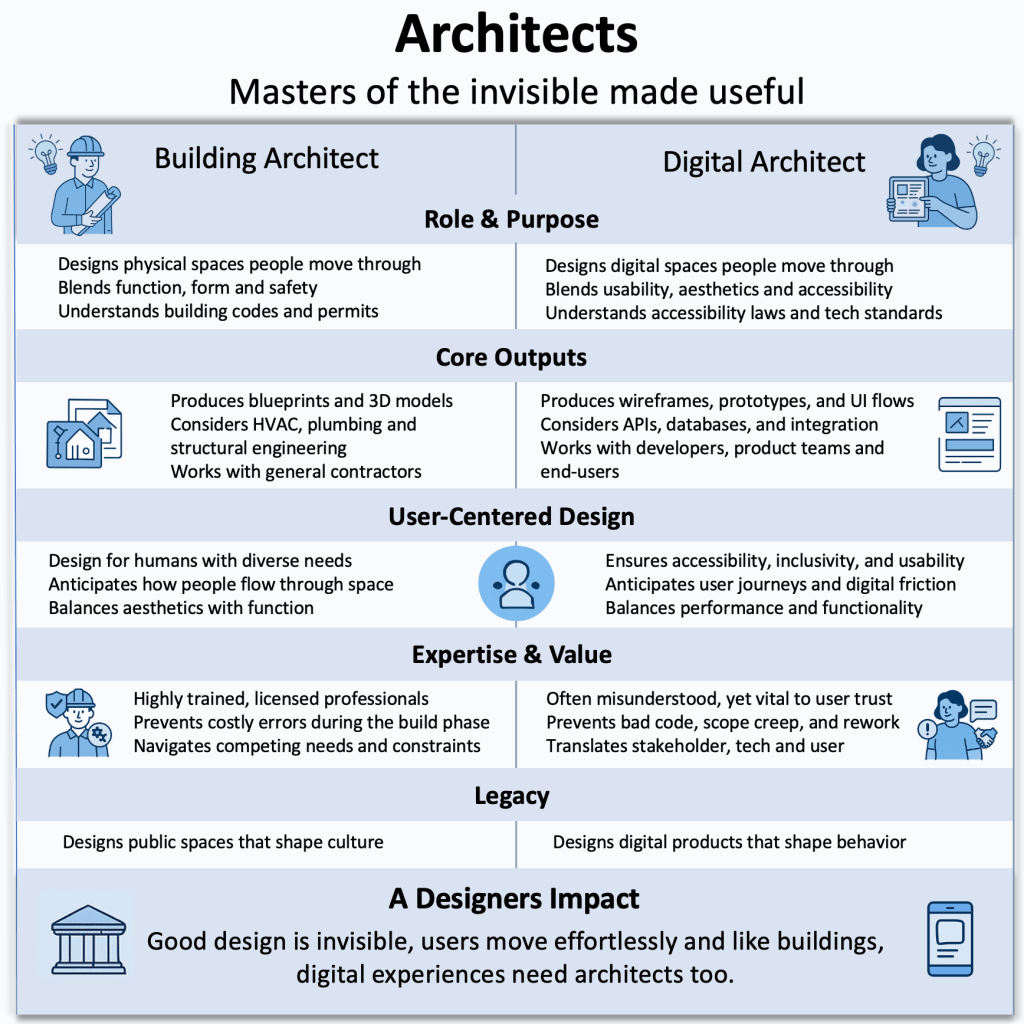
Making the invisible useful

I’ve been thinking a lot about the similarities between how we design physical spaces and how we design digital ones. Just like a building starts as an idea in an architect’s mind, so are the products that I work on and help a multitude of organizations bring to life. As a designer, I help lay the foundations for a product idea by thoroughly understanding the motivations and needs behind it, and what benefits and improvements implementing it would bring.

Buildings serve needs by providing housing for people or serving as places to work, and for businesses and organizations to operate. A well-designed building offers an effortless flow that draws people in and makes them want to stay. Similarly, great digital design allows for seamless navigation, creating an experience that feels natural and engaging. Before an architect devises plans and drawings for a building, they must first maintain a clear vision of the idea in their mind, understand the needs behind it and ensure that their designs and plans meet those needs.

From there, the idea and concept of the building in the architect’s mind are translated into plans and drawings. Those plans are drawn and shared with a builder, who in turn collaborates with the architect to bring them to life. Without the architect and their clear vision of the idea and concept behind the building, the building would not exist, at least not in the shape and form that the architect would have imagined. It would not properly serve the needs and bring about the benefits that accompanied the original idea.

Just like a building architect, as a product architect I must also understand the needs behind digital products to create experiences that truly serve the user. Through this process, I envision flows and interactions that will enable users to achieve their goals in the simplest and easiest way possible, reducing friction while also achieving the desired business value and benefit. Like an architect, I collaborate with members of technical teams so that the idea behind the product can be realized to its full potential through detailed roadmaps, designs and prototypes.

Figure 1. Architects are masters of the invisible made useful.

An architect must possess technical and creative skills that enable them to visualize the idea of a building. The same is true for me as a product architect. Without the ability to clearly articulate complex technical concepts through detailed designs and specifications while also applying a creative lens, product ideas would not be realized to their full potential.

In summary, how do I define my work? My work is about helping clients and organizations bring their ideas to life, transforming understanding into development, and development into reality, with as little friction and as much functionality as possible. I can help you and your organization achieve the same. Let me show you how.

Quantum Computing: Revolutionizing Industry and Science

We can imagine a world where quantum computers will be able to design powerful new drugs by simulating the behaviour of individual molecules, and optimize complex supply chains to help companies source the parts they need and assemble products in the most efficient way possible.

Introduction

Quantum computing is an entirely new dimension of computing leveraging the laws of quantum mechanics. Quantum computers apply superposition and entanglement at the universe’s smallest scales and coldest temperatures. They also adopt a multidisciplinary approach comprising of computer science, physics and mathematics to enable scientist to solve complex problems.

While today’s quantum computers remain rudimentary and error-prone, they have the potential to provide significant performance gains, and dramatically increased computation speeds to perform complex computational tasks that can take classical computers years to complete. Numerous governments, universities and vendors around the world are investing heavily in harnessing quantum computing technology to achieve fault-tolerant and reliable systems.

In this article, I provide a detailed examination of the key concepts underlying quantum computers, and how they promise to open the potential for massive advancements in a variety of scientific and industrial applications.

Superposition and entanglement

Qubits are the most basic units of processing in quantum computers. Qubits rely on the use of particles such electrons and photons, that can be suspended in states of 0, 1 or any states in between. This ability of qubits to be in more than one state at a time is what gives quantum computers their processing power. However, it is the application of superposition and entanglement through interference to qubits that allow quantum computers to produce reliable outcomes.

To better understand superposition, we refer to the famous thought experiment involving a cat as imagined by the physicist, Erwin Shrödinger. Shrödinger’s experiment imagined a cat sealed in a box with a poison trap that can be triggered by a decaying radioactive atom. Since the decay of the radioactive atom is uncertain, at any given moment the cat could be in a superposition of states such that it is either dead or alive [1]. It is only when someone opens the box and observes the cat does its state become definite or its state “collapses” to being either dead or alive.

Superposition is difficult to explain through analogies; however it is also possible to imagine a coin tossed and spinning fast in the air. As long as the coin continues spinning then its state can be considered both heads and tails. It is only when the coin is stopped does one observe its state as either heads or tails.  

Quantum theory also implies that particles can be linked with each other, such that when the state of one particle changes it will instantly impact the state of the other, regardless of the distance between them. This is what is referred to as entanglement, and it is what allows qubits to correlate their states with each other and thus scale their processing power exponentially.

In Shrödinger’s cat experiment, entanglement can be described as having several cats in the box that are entangled in a superposition of states such all cats in the box are either dead or alive. When someone opens the box, their state then collapses such that the cats in the box are all observed to be either dead or alive. Entanglement means that two particles are always connected, and they are never independent of each other. This is how nature works at the atomic level.   

Interference

Quantum interference refers to a phenomenon where the probability amplitudes of quantum states combine, either constructively or destructively, to influence the likelihood of an outcome. In classical interference, physical waves such as sound or water can overlap such that they amplify or cancel each other out. Quantum interference is different in that is it based on the wave-like behaviour of particles such as electrons, photons and atoms [2].

In quantum theory, particles are described via wavefunctions, which contain complex-value probability amplitudes. We can think of a particle going through two indistinguishable paths such as two slits in a barrier as the two-slit experiment describes. In this experiment, particles such as photons or electrons are fired one at a time at a wall with two narrow slits and a screen placed behind it. Each particle must pass through slit A, slit B or a combination of both. The expectation would be that particles would pass through one slit or the other, and that the screen would show two bright spots as the particles pass through.

Instead of observing two spots on the screen, a series of bright and dark fringes are observed – an interference pattern. The fringe pattern is characteristic of the behaviour of waves rather than particles, where the bright areas indicate wave amplitudes that amplified each other, while the dark ones are waves that canceled out. This behaviour can be described as [3]:

  • Constructive interference, where the wave amplitudes add up, thus increasing the probability of a particular outcome.
  • Destructive interference, where the amplitudes cancel each other out, thus reducing or eliminating the chance of an outcome.

What is fascinating about the fringe pattern observed is that it can appear even when particles are sent one at a time. Therefore, instead of interfering with each other particles are interfering with themselves, thus taking both paths simultaneously in superposition.

Interference is what gives quantum computers their superiority over classical computers. It allows quantum systems to guide computations by enhancing the probability of correct answers while supressing wrong ones. Once qubits are transformed and entangled, their probability amplitudes evolve through interference. All possible computations are performed simultaneously and are allowed to interact through entanglement.

A critical condition of interference is that the paths followed by qubits are indistinguishable, such that it is not possible to determine which path a qubit takes, even in principle. Any form of measurement collapses the wavefunction, thus destroying the superposition and possibility of interference. Interference underlies the power of quantum computing, and it remains a key component in unlocking the full potential of quantum technology.

Measurement

In the final stage of quantum computing, states collapse into classical outcomes upon measurement. These outcomes are not random and are fundamentally determined by whether computational paths leading to them have interfered constructively or destructively.

A state where computational paths leading to it have interfered destructively will have a probability close to 0. Similarly, a state where computational paths leading to it have interfered constructively will have a significantly amplified likelihood.

Instead of measuring outcomes sequentially, quantum computers exploit the wave-like nature of qubits to allow all possible computational paths to co-exist and interfere. This creates a probabilistic landscape where the correct answers become the most likely outcomes.

Quantum bits (Qubits)

Computers process information using bits that store information using 0’s and 1’s. Bits can be represented using physical objects such as bar magnets or switches placed in either a state of up or down. Bits can maintain their state for a long time, thus allowing them to represent stored information in a stable and long-lasting fashion. However, bits are limited in their ability to store information when compared to qubits. While bits can exist in either a stare of 0 or 1, qubits can exist in a superposition of multiple states of 0, 1 or any state in between.

The superposition of qubits is what makes them superior to classical bits. It is possible to think of a qubit as an electron spinning in a magnetic field. The electron could be spinning with the field, known as spin-up state, or against the field, knows as spin-down state. Suppose it is possible to change the direction of the electron’s spin using a pulse of energy such as a laser. If only half a pulse of laser energy is used and all external influences are isolated, then we can imagine the electron in superposition where it is in all possible states at once [4].

Superposition increases the computational power of qubits exponentially depending on the number of qubits in a quantum computer. Whereas two classical bits can contain only two pieces of information (01 and 10), two qubits can store a superposition of four combinations of 0 and 1 simultaneously, three qubits can store eight combinations, and so on. Therefore, a quantum computer can perform 2N computations, where N is the number of qubits.

Conclusion

Through exponential scaling, unique algorithms and the continued evolution of quantum hardware, quantum computing has the potential to revolutionize industries like cryptography, material science, pharmaceuticals and logistics. We can imagine a world where quantum computers will be able to design powerful new drugs by simulating the behaviour of individual molecules, and optimize complex supply chains to help companies source the parts they need and assemble products in the most efficient way possible. Other more impactful applications could be computers that could break the encryption that safeguards our private information on the internet.

Governments, companies and research labs are working tirelessly to harness the potential of this emerging technology. Quantum computing, combined with the capabilities and advancements in AI, has the potential to achieve artificial general intelligence (AGI). By enabling rapid data processing and computation, improved learning capabilities and parallel processing, quantum computers can process extensive datasets, enabling the improved learning capabilities needed for AGI. As quantum computers continue to rapidly evolve, it is essential for us to harness their potential in ways that further advance humanity’s future and well-being.

References

[1] Quantum Computing Explained

[2] What is quantum interference and how does it work?

[3] Quantum interference in Quantum Computing: 2025 Full Guide

[4] What is quantum computing? How it works and examples

The Principles of Quantum Computing Explained

Today, a variety of companies are producing mainstream quantum hardware and making tools available to developers, turning quantum computing technology that was theoretical a few decades ago into a reality.

Introduction

During one of his Messenger Lectures at MIT in 1964, the renowned Nobel prize laureate and theoretical physicist, Richard Feynman, was quoted as saying “I think I can safely say that no one can understand quantum mechanics”. Feynman emphasized the counter intuitiveness of quantum mechanics, and encouraged listeners at his lecture to simply accept how atoms behave at the quantum level, rather than trying to apply a classical understanding onto it [1].

At its core, quantum theory describes how light and matter behave at the subatomic level. Quantum theory explains how particles can appear in two different places at the same time, how light can behave both as a particle and a wave, and how electrical current can flow both clockwise and counter-clockwise in a wire. These ideas can seem strange to us, even bizarre, yet quantum mechanics gave rise to a new world of possibilities science, technology and information processing.

What is a quantum computer?

While classical computers use bits that can be either 0 or 1, quantum computers use quantum bits (qubits) that can be 0, 1 or both at the same time, suspended in superposition. Qubits are created by manipulating and measuring systems that exhibit quantum mechanical behaviour. Because qubits can hold superposition and exhibit interference, they can solve problems differently than classical computers.

Quantum computers perform quantum computations by manipulating the quantum states of qubits in a controlled way to perform algorithms [2]. Quantum computers can adopt an arbitrary quantum state from an arbitrary input quantum state. This enables quantum computers to accurately compute the behaviour of small particles that follow the laws of quantum mechanics, such as the behaviour of an electron in a hydrogen molecule. Quantum computers can also be used to efficiently run optimization and machine learning algorithms.

For example, a classical computer might apply a brute force method to solve a maze by trying every possible path and remembering the paths that don’t work. A quantum computer, on the other hand, may not need to test all paths in the maze to arrive at the solution. Instead, given a snapshot of the maze, a quantum computer relies on measuring the probability amplitudes of qubits to determine the outcome. Since the amplitudes behave like waves, the solution is found when the waves overlap.

Principles of quantum computing

Quantum computing relies on four key principles:

Superposition – represents all possible combinations of a qubit through a complex multi-dimensional computational space. Superposition allows the representation of complex problems in new ways using these computational spaces. The quantum state is measured by collapsing it from the superposition of possibilities into a binary state that can be registered as binary code using 0 and 1[3].   

Entanglement – the ability of qubits to correlate their state with other qubits. Entanglement implies close connections among qubits in a quantum system, such that each qubit can immediately determine information about other qubits in the system.

Interference – qubits placed in a state of collective superposition structure information in a way that looks like waves, with amplitudes associated with each wave. These waves can either peak at a particular level or cancel each other out, thus amplifying the probability or canceling it out for a specific outcome. Amplifying or canceling out a probability are both forms of interference.

Decoherence – occurs when a system collapses from a quantum state to a non-quantum state. This can be triggered intentionally through measurement of the quantum system or other unintentional factors. Quantum computers require avoiding or minimizing decoherence.                 

Combining these principles can help explain how quantum computers work. By preparing a superposition of quantum states, a quantum circuit written by the user uses operations to entangle qubits and generate interference patterns, as governed by a quantum algorithm. Outcomes are either canceled out or amplified through interference, and the amplified outcomes serve as the solution to the computation.

Conclusion

Today, a variety of companies are producing mainstream quantum hardware and making tools available to developers, turning quantum computing technology that was theoretical a few decades ago into a reality. Superconducting quantum processors are being delivered at regular intervals, increasing quantum computing speed and capacity. Researchers are continuing to make quantum computers even more useful, while overcoming challenges related to scaling quantum hardware and software, quantum error correction and quantum algorithms.


Designing solutions that work for users is what fuels my work. I’d love to connect and talk through your design ideas or challenges, connect with me today on LinkedIn or contact me at Mimico Design House.


References

[1] Quantum Mechanics by Richard P. Feynman

[2] The basics of Quantum Computing

[3] What is quantum computing?