
Quantum Revolution: How Max Planck Tapped Into the Universe’s Zero-Point Mysteries

Unveiling the Ever-Vibrant Fabric of Reality

Introduction

At the dawn of the twentieth century, Max Planck embarked on a quest to unravel how energy is absorbed and emitted by the filaments within light bulbs, aiming to maximize their efficiency and illuminate more while consuming less power. In doing so, Planck not only resolved practical engineering challenges, but also ignited a scientific revolution that fundamentally reshaped our comprehension of physics and the universe itself.

Planck’s investigations shattered the classical notion that energy flows in a seamless, continuous stream. Instead, he revealed that energy is exchanged in tiny, indivisible packets known as quanta. This radical insight gave birth to quantum theory, a new framework that challenged long-held assumptions and transformed our understanding of the physical world, from the behaviour of the smallest particles to the structure of the cosmos.

The significance of Planck’s discovery extends far beyond theoretical physics. By demonstrating that energy exchanges are quantized, he opened the door to a wave of scientific breakthroughs, paving the way for technologies such as semiconductors, lasers, and quantum computing. Moreover, subsequent research based on Planck’s work uncovered the existence of zero-point energy: even in the coldest conceivable state, where classical theory predicted absolute stillness, quantum systems retain a subtle but unceasing vibrancy. This revelation overturned the classical thermodynamic belief that all motion ceases at absolute zero, unveiling a universe in perpetual motion at its most fundamental level.

Planck’s legacy is profound, not only did he lay the foundations for quantum mechanics, but his insights continue to inspire new discoveries that help us probe the mysteries of existence. By deepening our grasp of reality’s underlying fabric, Planck’s work has transformed how we see our place in the universe, inviting us to explore how the strange and wonderful quantum world shapes everything from the nature of matter to the emergence of life itself.

The Black Body Problem and Ultraviolet Catastrophe

As the nineteenth century turned, new technologies such as the light bulb drove increased interest in the interaction between materials and radiation. Efficient engineering of light bulbs demanded a deeper understanding of how materials absorb and emit energy, especially the filaments inside the bulbs. In the early 1890s, the German Bureau of Standards commissioned Planck to optimize light bulb efficiency by identifying the temperature at which bulbs would radiate mainly in the visible spectrum while minimizing energy loss in the ultraviolet and infrared regions [1].

Prior attempts to explain the behaviour of heated materials, notably the Raleigh-Jeans law, predicted infinite energy emission at short wavelengths – the so-called ultraviolet catastrophe. These models often relied on the concept of an ideal material that perfectly absorbs all wavelengths, termed a black body. The ultraviolet catastrophe led directly to the “black body problem,” as experimental results contradicted the notion that materials like lightbulb filaments would emit infinite energy at high temperatures.

Planck addressed this issue by conducting experiments with electrically charged oscillators in cavities filled with black body radiation. He discovered that the oscillator could only change its energy in minimal increments, later quantified as h (Planck’s constant). The energy exchanged was proportional to the frequency of the electromagnetic wave and occurred in discrete quantities, or quanta. This finding gave rise to quantum theory and revealed a deeper truth: energy remains with the oscillator (or the atoms in the material) even at absolute zero temperature.

Zero-Point Energy and Its Implications

By solving the ultraviolet catastrophe through his black body absorption equation, Planck discovered zero-point energy (ZPE). Unlike the catastrophe, the existence of zero-point energy was verified experimentally, overturning classical thermodynamics’ expectation that all molecular motion would cease at absolute zero.

Zero-point energy accounts for phenomena such as vacuum-state fluctuations, where even an electromagnetic field with no photons is not truly empty but exhibits constant fluctuations due to ZPE. One of the most fascinating examples is the Gecko – a lizard capable of traversing walls and ceilings on nearly any material. The Gecko exploits quantum vacuum fluctuations present in the zero-point energy of the electromagnetic field. Its feet are covered with millions of microscopic hairs that interact with the quantum vacuum fluctuations of any nearby surface, resulting in an attractive force known as van der Waals force, a microscopic form of the Casimir effect. Through this process, the Gecko draws energy from the vacuum field, demonstrating nature’s ability to harness zero-point energy.

Experimental Advances in Harnessing Zero-Point Energy

Research teams from Purdue University and the University of Colorado Boulder have shown that energy from the vacuum state can be accessed through the Casimir force, which acts on micro-sized plates in experimental setups. Although the effect is small and produces limited energy, more efficient methods may be possible using quantum vacuum density and spin. The impact of spin is visible in fluid systems like hurricanes and tornadoes. By inducing high angular momentum vortices with plasma coupled to the quantum vacuum, researchers can create energy gradients much larger than those observed with simple non-conductive plates in the Casimir effect.

These pioneering investigations illuminate how quantum phenomena, once confined to abstract theory, are now being harnessed in the laboratory to extract measurable effects from the very fabric of space. While the practical application of zero-point energy remains in its infancy, the ongoing refinement of experimental techniques – such as manipulating spin and plasma interactions – offers glimpses of a future where the subtle energy fields underlying all matter could become a resource for technological innovation. Each advance deepens our appreciation for the intricate interplay between quantum mechanics and the observable world, suggesting that the restless energy pervading the vacuum is not merely a curiosity, but a potential wellspring of discovery and transformation that may one day reshape our understanding of both energy and existence.

Conclusion

Max Planck’s pursuit to optimize the humble light bulb did far more than revolutionize technology, it opened a window into the deepest workings of the universe. By questioning how filaments absorb and emit energy, Planck uncovered the quantum nature of reality, revealing that energy is exchanged in discrete packets, or quanta, rather than in a continuous flow. This insight not only solved the black body problem and the ultraviolet catastrophe but also led to the discovery of zero-point energy, the realization that even at absolute zero, particles never truly rest, and the universe itself is in perpetual motion. 

Zero-point energy shows us that nothing in the cosmos is permanent. Particles continuously move, shift, and even appear and disappear, embodying a universe that is dynamic and ever-changing. As humans, we are inseparable from this cosmic dance. Our bodies, thoughts, and lives are woven from the same quantum fabric, always in flux, always evolving. Planck’s work reminds us that change is not just inevitable, it is fundamental to existence itself. In understanding zero-point energy, we come to see that reality is not a static backdrop, but a vibrant, restless sea of possibility, where both matter and meaning are constantly being created and transformed.
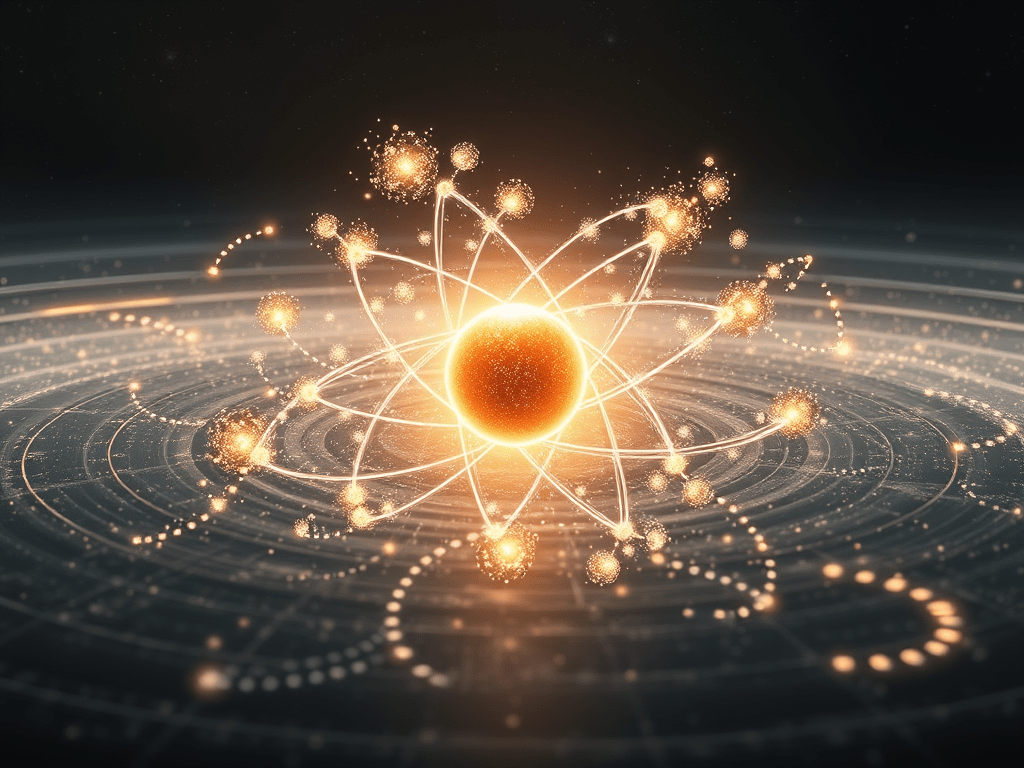
The Quantum Realm: Our Connection to the Universe

At the quantum scale, the universe manifests as a field of infinite possibilities, where the electrons within our atoms move in clouds of probability, always shifting. Consequently, we, as humans composed of countless atoms, are an inseparable part of the universe’s ever-changing nature, and our problems, at the quantum level, do not really exist.

Introduction 

When we close our eyes and place our hand on our forehead, we perceive the firmness of our hand and the gentle warmth of our skin. This physical sensation, the apparent solidity and presence of our body, seems tangible and reassuring. However, at the most fundamental level, our bodies are composed almost entirely of empty space. Beneath the surface of our bones, tissues, and cells, we find that our physical form is constructed from atoms, which themselves are predominantly made up of empty space, held together by the invisible forces of electromagnetism. The idea that we are, in essence, built from empty space can feel unsettling, yet it is central to our understanding of quantum mechanics.   

If we imagine an atom, and picture a single proton as a grain of sand placed at the centre of a football stadium, the nearest electron would be found somewhere in the outer bleachers, approximately 90 metres away. The vast expanse between the proton and the electron is filled with nothing but empty space [1]. The electrons themselves do not orbit the nucleus like tiny marbles following a fixed path. Instead, they ripple through space in a cloud-like manner, appearing in one location at one moment, and in another the next. Their movement is not governed by certainty, but by the probability clouds that define their position and momentum.    

The Universe Is Impermanent

Everything in the universe is in a state of constant motion. Objects such as chairs and tables may appear completely motionless to our eyes, yet at the quantum level, this sense of stillness is an illusion. Even as we sleep and perceive ourselves to be at rest, the atoms that make up our bodies are ceaselessly moving and vibrating. This underlying activity is dictated by the principles of quantum mechanics, which reveal an intricate and dynamic world beneath the surface of everyday experience.

Werner Heisenberg’s uncertainty principle states that it is impossible to simultaneously know both the precise position and the exact momentum of any object [2]. The more accurately we measure one, the less certain we become of the other. This fundamental limit means that no object can ever be fixed in a single, definite spot while remaining absolutely still. To do so would violate the laws of quantum physics, which require all matter to retain a degree of movement and uncertainty 

Consider a ball placed in a bowl and cooled until it appears perfectly still at the bottom. According to the uncertainty principle, the ball can never truly be at rest. It will always exhibit a subtle vibration, as restricting its position too precisely leads to uncertainty in its momentum. This perpetual motion is known as the ball’s zero-point energy.  

A universe where everything is perfectly still would not permit life as we know it. Nothing in the cosmos is permanent; particles continuously move, shift, and even appear and disappear. Remarkably, quantum theory predicts that even the vacuum of space is not empty but is filled with modes of vibration possessing zero-point energy [3]. This means that space itself is permeated by an endless and restless sea of energy, where particles are constantly popping in and out of existence, reflecting the ever-changing nature of reality.  

Quantum Mechanics and the Foundations of Consciousness 

At the quantum level, the behaviour of particles is defined by several extraordinary phenomena, including superposition, entanglement, coherence, and the observer effect. In the phenomenon known as superposition, particles can exist in multiple states at the same time. These particles remain in superposition until an act of observation occurs, causing their wave functions to collapse into a single, definite outcome. When two particles interact and become entangled, their properties, such as spin, polarization, and momentum, become fundamentally inseparable. Measurement of one entangled particle instantly determines the state of its partner, regardless of the distance separating them. 

Humans are deeply entangled with the inner workings of the universe. Our thoughts, memories, and emotions are rooted in the quantum behaviours of the atoms that compose our bodies. Consciousness, in this context, is shaped and defined through quantum operations. The billions of neurons firing simultaneously in the human brain function through quantum entanglement, collectively giving rise to our conscious experience [4]

Stuart Hameroff and Roger Penrose, in their 1996 paper, argued that consciousness depends on coherent quantum processes within collections of microtubules found in brain neurons. At the lowest neurophysiological level, the cytoskeleton of neurons in the human brain is composed of protein networks, specifically neurofilaments and microtubuli. These structures are essential for various transport processes within neurons [5] [6]. According to Hameroff and Penrose’s theoretical framework, tubulins in microtubuli serve as the substrate for quantum processes. 

Through their Orchestrated Objective Reduction (Orch OR) theory, Hameroff and Penrose proposed that the brain’s microtubules act as quantum computers, maintaining coherent quantum states that collapse in a process tied to the geometry of space-time and influenced by quantum gravity. In this framework, consciousness operates as a quantum wave function passing through the brain’s microtubuli, with these collapses corresponding to the observer’s elementary acts of consciousness and embedding them directly into the fabric of the universe. 

Conclusion 

Contemplating the foundations of our bodies and consciousness, it becomes apparent that quantum mechanics may govern much more than just the biological processes within us. While the Orch OR theory proposed by Hameroff and Penrose remains a topic of debate, it opens the door to the possibility that consciousness arises not solely from biological functions but also from quantum phenomena.

In quantum computing, the act of observation is inherently influential, determining the state to which a particle’s wave function collapses. This raises a profound question: could quantum mechanics provide an explanation for our ability to perceive and realize different realities within our consciousness? Furthermore, could our observation of quantum states, which shape our consciousness, be the very mechanism that connects us to the universe in a holistic manner?

I found that for me, the most meaningful way to think about it was that the concept of uncertainty and constant motion is central to how the universe operates at the quantum level. If our bodies and consciousness are subject to the laws of quantum physics, then our experiences of periods of darkness and despair, feelings of being stuck or hopeless, are never truly fixed states. Motion persists within our atoms and within our consciousness, regardless of our perceptions. The pressure we experience, the everyday stresses, and our emotions are all shaped by how we observe and interpret events. At the quantum level, nothing remains permanent; everything is in flux.

This perspective is not meant to diminish our existence as human beings. Rather, it highlights our intrinsic connection to the fabric of the universe. The universe does not operate with absolute certainty or permanence; it is defined by uncertainty, continual change, and movement. At the quantum scale, the universe manifests as a field of infinite possibilities, where the electrons within our atoms move in clouds of probability, always shifting. Consequently, we, as humans composed of countless atoms, are an inseparable part of the universe’s ever-changing nature, and our problems, at the quantum level, do not really exist.


Designing solutions that effectively meet user needs is the driving force behind my work. I also share practical insights on computing and human-centered design each week. I’d love to connect and discuss your design ideas or challenges; feel free to reach out to me today on LinkedIn or contact me at Mimico Design House.