Quantum Entanglement: ‘Spooky Action at a Distance’

The atoms that comprise all matter – including those composing our bodies – originated from distant stars and galaxies, emphasizing our intrinsic connection to the universe at fundamental scales. It is perhaps an inescapable conclusion that our reality is defined by how we observe and view our universe, and everything within it.
Introduction

In 1935, Albert Einstein, Boris Podolsky, and Nathan Rosen published a paper addressing the conceptual challenges posed by quantum entanglement [1]. These physicists argued that quantum entanglement appeared to conflict with established physical laws and suggested that existing explanations were incomplete without the inclusion of undiscovered properties, referred to as hidden variables. This argument, later termed the EPR argument, underscored perceived gaps in quantum mechanics.

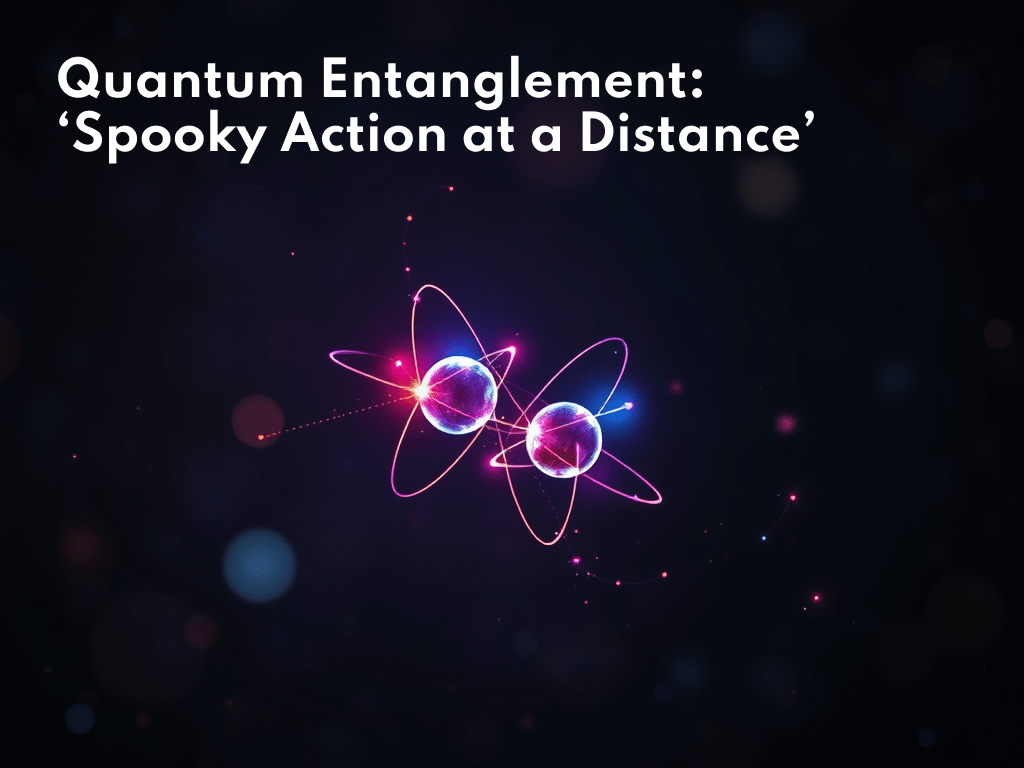
Quantum entanglement represents a significant and intriguing phenomenon within quantum mechanics. It describes a situation wherein the characteristics of one particle within an entangled pair are dependent on those of its partner, regardless of the spatial separation between them. The particles involved may be electrons or photons, with properties such as spin direction serving as examples. Fundamentally, entanglement is based on quantum superposition: particles occupy multiple potential states until observation forces the system into a definite state. This state collapse occurs instantaneously for both particles.

The implication that measuring one particle’s property immediately determines the corresponding property of the other – even across vast cosmic distances – suggests the transmission of information at speeds exceeding that of light. This notion appeared to contradict foundational principles of physics as understood by Einstein, who referred to quantum entanglement as “spooky action at a distance” and advocated for a more satisfactory theoretical explanation.

Modern understanding of entanglement

The EPR argument highlighted the conventional concept of reality as consisting of entities with physical properties that are revealed through measurement. Einstein’s theory of relativity is based on this perspective, asserting that reality must be local and that no influence can propagate faster than the speed of light [2]. The EPR analysis demonstrated that quantum mechanics does not align with these principles of local reality, suggesting that a more comprehensive theory may be required to fully describe physical phenomena.

It was not until the 1960s that advances in technology and clearer definitions of measurement permitted physicists to investigate whether hidden variables were necessary to complete quantum theory. In 1964, Irish physicist John S. Bell formulated an equation, Bell’s inequality, which holds true for hidden variable theories but not exclusively for quantum mechanics. If real-world experiments failed to satisfy Bell’s equation, hidden variables could be excluded as an explanation for quantum entanglement.

In 2022, the Nobel Prize in Physics honored Alain Aspect, John Clauser, and Anton Zeilinger for their pioneering experiments utilizing Bell’s inequality, which significantly advanced our understanding of quantum entanglement. Unlike earlier thought experiments involving pairs of electrons and positrons, their work employed entangled photons. Their findings definitively eliminated the possibility of hidden variables and confirmed that particles can exhibit correlations across vast distances, challenging pre-quantum mechanical interpretations of physics.

Furthermore, these experiments demonstrated that quantum mechanics is compatible with special relativity. The collapse of the states of two entangled particles upon measurement does not entail information transfer exceeding the speed of light; rather, it reveals a correlation between entangled particle states governed by randomness and probability, such that measuring one immediately determines the state of the other.

Conclusion

When he called it “spooky action at a distance”, Einstein sought to understand entanglement within the context of local reality. The EPR argument subsequently highlighted the non-local nature of reality through quantum entanglement. Although information cannot be transmitted faster than the speed of light, quantum entanglement demonstrates that the states of entangled particles exhibit instantaneous correlations, ensuring that any transfer of information remains consistent with causality and relativity.

Quantum entanglement underscores the indeterminate nature of reality prior to observation. Rather than existing as predetermined outcomes, reality according to quantum systems resides within vast fields of probability that are defined upon measurement. Additionally, the atoms that comprise all matter – including those composing our bodies – originated from distant stars and galaxies, emphasizing our intrinsic connection to the universe at fundamental scales. It is perhaps an inescapable conclusion that our reality is defined by how we observe and view our universe and, everything within it.

The Quantum Realm: Our Connection to the Universe

At the quantum scale, the universe manifests as a field of infinite possibilities, where the electrons within our atoms move in clouds of probability, always shifting. Consequently, we, as humans composed of countless atoms, are an inseparable part of the universe’s ever-changing nature, and our problems, at the quantum level, do not really exist.

Introduction 

When we close our eyes and place our hand on our forehead, we perceive the firmness of our hand and the gentle warmth of our skin. This physical sensation, the apparent solidity and presence of our body, seems tangible and reassuring. However, at the most fundamental level, our bodies are composed almost entirely of empty space. Beneath the surface of our bones, tissues, and cells, we find that our physical form is constructed from atoms, which themselves are predominantly made up of empty space, held together by the invisible forces of electromagnetism. The idea that we are, in essence, built from empty space can feel unsettling, yet it is central to our understanding of quantum mechanics.   

If we imagine an atom, and picture a single proton as a grain of sand placed at the centre of a football stadium, the nearest electron would be found somewhere in the outer bleachers, approximately 90 metres away. The vast expanse between the proton and the electron is filled with nothing but empty space [1]. The electrons themselves do not orbit the nucleus like tiny marbles following a fixed path. Instead, they ripple through space in a cloud-like manner, appearing in one location at one moment, and in another the next. Their movement is not governed by certainty, but by the probability clouds that define their position and momentum.    

The Universe Is Impermanent

Everything in the universe is in a state of constant motion. Objects such as chairs and tables may appear completely motionless to our eyes, yet at the quantum level, this sense of stillness is an illusion. Even as we sleep and perceive ourselves to be at rest, the atoms that make up our bodies are ceaselessly moving and vibrating. This underlying activity is dictated by the principles of quantum mechanics, which reveal an intricate and dynamic world beneath the surface of everyday experience.

Werner Heisenberg’s uncertainty principle states that it is impossible to simultaneously know both the precise position and the exact momentum of any object [2]. The more accurately we measure one, the less certain we become of the other. This fundamental limit means that no object can ever be fixed in a single, definite spot while remaining absolutely still. To do so would violate the laws of quantum physics, which require all matter to retain a degree of movement and uncertainty 

Consider a ball placed in a bowl and cooled until it appears perfectly still at the bottom. According to the uncertainty principle, the ball can never truly be at rest. It will always exhibit a subtle vibration, as restricting its position too precisely leads to uncertainty in its momentum. This perpetual motion is known as the ball’s zero-point energy.  

A universe where everything is perfectly still would not permit life as we know it. Nothing in the cosmos is permanent; particles continuously move, shift, and even appear and disappear. Remarkably, quantum theory predicts that even the vacuum of space is not empty but is filled with modes of vibration possessing zero-point energy [3]. This means that space itself is permeated by an endless and restless sea of energy, where particles are constantly popping in and out of existence, reflecting the ever-changing nature of reality.  

Quantum Mechanics and the Foundations of Consciousness 

At the quantum level, the behaviour of particles is defined by several extraordinary phenomena, including superposition, entanglement, coherence, and the observer effect. In the phenomenon known as superposition, particles can exist in multiple states at the same time. These particles remain in superposition until an act of observation occurs, causing their wave functions to collapse into a single, definite outcome. When two particles interact and become entangled, their properties, such as spin, polarization, and momentum, become fundamentally inseparable. Measurement of one entangled particle instantly determines the state of its partner, regardless of the distance separating them. 

Humans are deeply entangled with the inner workings of the universe. Our thoughts, memories, and emotions are rooted in the quantum behaviours of the atoms that compose our bodies. Consciousness, in this context, is shaped and defined through quantum operations. The billions of neurons firing simultaneously in the human brain function through quantum entanglement, collectively giving rise to our conscious experience [4]

Stuart Hameroff and Roger Penrose, in their 1996 paper, argued that consciousness depends on coherent quantum processes within collections of microtubules found in brain neurons. At the lowest neurophysiological level, the cytoskeleton of neurons in the human brain is composed of protein networks, specifically neurofilaments and microtubuli. These structures are essential for various transport processes within neurons [5] [6]. According to Hameroff and Penrose’s theoretical framework, tubulins in microtubuli serve as the substrate for quantum processes. 

Through their Orchestrated Objective Reduction (Orch OR) theory, Hameroff and Penrose proposed that the brain’s microtubules act as quantum computers, maintaining coherent quantum states that collapse in a process tied to the geometry of space-time and influenced by quantum gravity. In this framework, consciousness operates as a quantum wave function passing through the brain’s microtubuli, with these collapses corresponding to the observer’s elementary acts of consciousness and embedding them directly into the fabric of the universe. 

Conclusion 

Contemplating the foundations of our bodies and consciousness, it becomes apparent that quantum mechanics may govern much more than just the biological processes within us. While the Orch OR theory proposed by Hameroff and Penrose remains a topic of debate, it opens the door to the possibility that consciousness arises not solely from biological functions but also from quantum phenomena.

In quantum computing, the act of observation is inherently influential, determining the state to which a particle’s wave function collapses. This raises a profound question: could quantum mechanics provide an explanation for our ability to perceive and realize different realities within our consciousness? Furthermore, could our observation of quantum states, which shape our consciousness, be the very mechanism that connects us to the universe in a holistic manner?

I found that for me, the most meaningful way to think about it was that the concept of uncertainty and constant motion is central to how the universe operates at the quantum level. If our bodies and consciousness are subject to the laws of quantum physics, then our experiences of periods of darkness and despair, feelings of being stuck or hopeless, are never truly fixed states. Motion persists within our atoms and within our consciousness, regardless of our perceptions. The pressure we experience, the everyday stresses, and our emotions are all shaped by how we observe and interpret events. At the quantum level, nothing remains permanent; everything is in flux.

This perspective is not meant to diminish our existence as human beings. Rather, it highlights our intrinsic connection to the fabric of the universe. The universe does not operate with absolute certainty or permanence; it is defined by uncertainty, continual change, and movement. At the quantum scale, the universe manifests as a field of infinite possibilities, where the electrons within our atoms move in clouds of probability, always shifting. Consequently, we, as humans composed of countless atoms, are an inseparable part of the universe’s ever-changing nature, and our problems, at the quantum level, do not really exist.


Designing solutions that effectively meet user needs is the driving force behind my work. I also share practical insights on computing and human-centered design each week. I’d love to connect and discuss your design ideas or challenges; feel free to reach out to me today on LinkedIn or contact me at Mimico Design House.