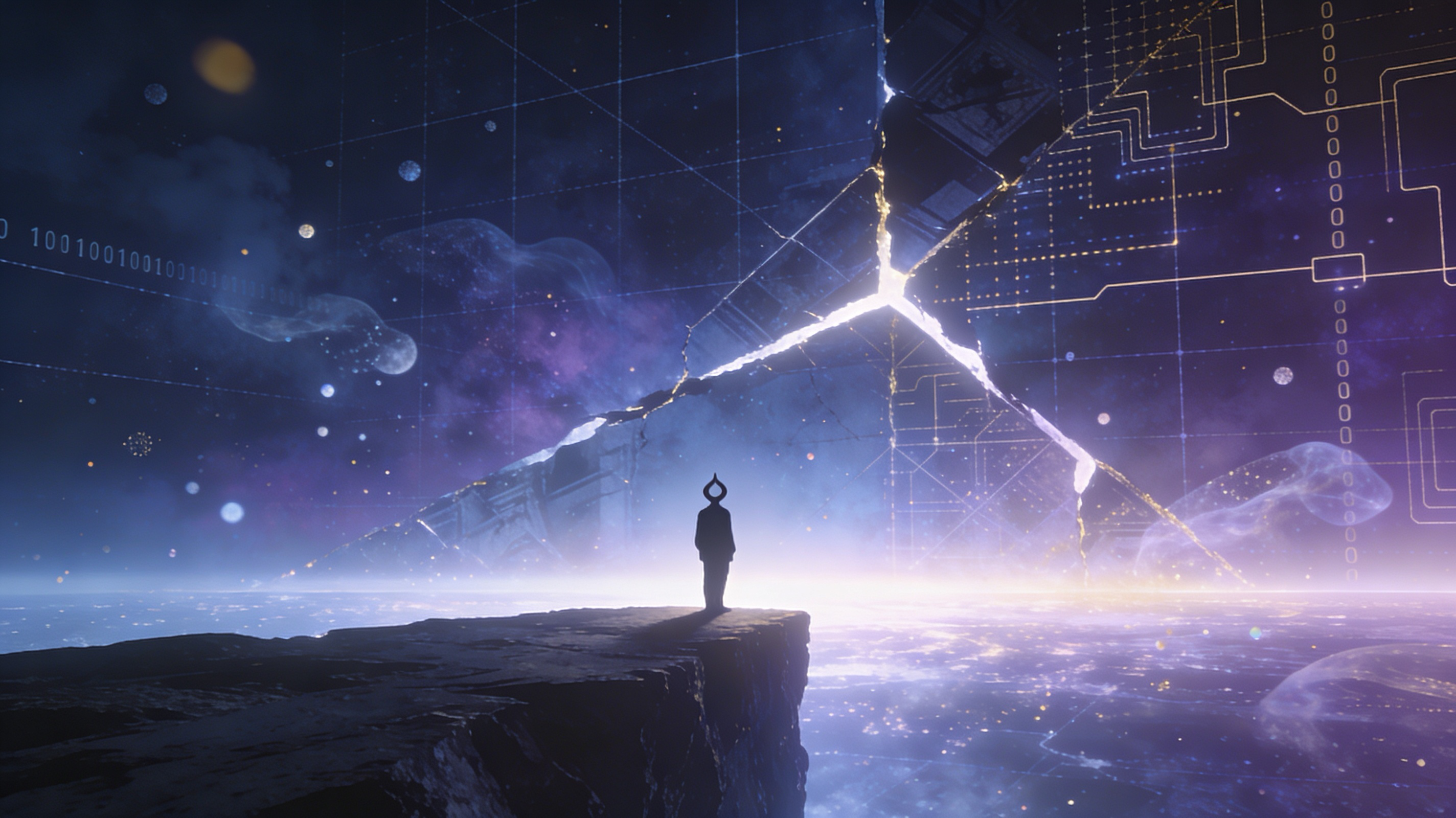
Turning Points in Human Knowledge
Progress sometimes comes in the form of dramatic disruptions that fundamentally change how we understand the world. These turning points challenge established paradigms and force us to reconsider assumptions that once seemed untouchable. Rather than building incrementally upon previous frameworks, these disruptions demand a complete reimagining of intellectual models, and challenge our understanding of certainty, causality, and independence. This is where the boundaries of knowledge and inquiry are questioned, and conventional wisdom becomes obsolete, introducing new ways of seeing and interpreting reality.
Profound change often reveals the limitations of frameworks that previously supported our understanding. The familiar patterns and established logic through which we understood the world, become inadequate for understanding the complexities of new intellectual concepts. As our thinking evolves, it becomes clear that reality may be shaped by concepts and structures vastly different from those we once considered universal. In this context, learning evolves from the pursuit of certainty to the exploration of possibility, as we seek to organize and interpret information that reflects the evolving nature of reality. The consequences of this change ripple through science, philosophy, technology, and culture, leaving a lasting mark on the collective consciousness and shaping the trajectory of civilization for generations.
The Quantum Computing Revolution
What is fascinating about quantum computing is how it exemplifies humanity’s ongoing quest to push the boundaries of knowledge. Quantum computing is not merely a new phase in technological development; it marks a profound turning point and a departure from previous approaches to understanding and utilizing computing power. Often described as a technological revolution, quantum computing demonstrates extraordinary capabilities, through machines that can tackle problems unsolvable by even the most advanced classical computers. While the speed and computational power are remarkable, they only hint at the deeper transformation underway. Quantum computing forces us to reconsider the very foundations of computation, information theory, and the systems that power our modern economies.
Traditional computers rely on binary states—bits that are either zero or one—while quantum computers use qubits, which can exist in multiple states simultaneously, thanks to the laws of quantum mechanics. The classical computational model, based on discrete transitions and predictable outcomes, is overturned by quantum phenomena that often defy logic. Superposition allows quantum systems to represent a combination of possibilities at once, vastly expanding computational strategies. Entanglement enables particles to form deep connections, such that the state of one influences the other instantly, regardless of distance. These principles are not just theoretical; they are the foundations underpinning the operational reality of quantum computers, and fundamentally distinguish them from their classical counterparts.
New Mechanisms and Paradigms
Superposition and entanglement are the mechanisms that govern how quantum computers operate. Harnessing these phenomena unlocks new modes of information processing and problem-solving that represent a complete departure from digital logic. The quantum computing paradigm is not only about achieving greater speed or efficiency; it unlocks computational approaches and results previously unimaginable, allowing us to tackle entirely new classes of problems and solutions.
Quantum computers are distinguished by their unique logic. Unlike classical computers, which rely on deterministic, binary operations, quantum systems process information using superposition and entanglement, defying conventional expectations. This quantum logic is not simply a more advanced form of digital computation; it is a fundamentally different framework, drawing from the mechanics of the universe itself. By leveraging the ability of qubits to exist in multiple states and influence each other instantly over distances, quantum computers achieve milestones that are unattainable for classical machines. These capabilities enable vast solution space exploration, parallel processing on an unprecedented scale, and the resolution of problems that would take classical computers centuries or longer.
As quantum principles are put into practice, quantum computing opens new avenues for scientific discovery, optimization, and secure communication. Quantum algorithms such as Shor’s for factoring large numbers or Grover’s for searching unsorted databases showcase not only faster solutions, but entirely new approaches to problem-solving. The impact is far-reaching, with potential applications in chemistry, materials science, finance, cryptography, and artificial intelligence. This represents a transformative leap, not only in computational power but in our perception of information, uncertainty, and interconnectedness. The quantum paradigm is allowing us to rethink boundaries, accept complexity and ambiguity, and embrace a worldview shaped by probability, superposition and entanglement.
The Journey into Quantum Understanding
To fully appreciate quantum computing, we must set aside established notions and explore a new conceptual landscape. This journey requires more than technical mastery; it demands a willingness to question our perception of information, computation, and even physical reality. Embracing quantum computing means accepting uncertainty, complexity, and interconnectedness as intrinsic elements of system design and analysis.
Quantum computing challenges us to rethink the construction of computers and the limits of knowledge itself. Standing at the threshold of uncharted intellectual territory, we face questions that are both technical and philosophical: What are the boundaries of what can be known? How do we organize, design and interpret information in a world where certainty is elusive and complexity fundamental? At the edge of understanding, quantum computing promises new dimensions and the potential to redefine what it means to comprehend and shape reality.
