Introduction
As quantum computing transitions from experimental platforms to scalable infrastructure, the field is witnessing a transformation reminiscent of the evolution of classical computing. Classical computers were initially monolithic, singular entities with integrated components, until eventually shifting towards modular architectures. These modular architectures introduced distributed systems, cloud infrastructures, microservices, and networked computation. Scalability was no longer reliant on building larger single machines but rather on connecting smaller units into cohesive systems.
Quantum computing is now experiencing the same paradigm shift. The main challenge lies in the transition from developing larger quantum processors to engineering scalable quantum systems through modular composition. This progression does not only highlight advances in engineering efficiency; it emphasizes the idea that advancements in quantum computing will depend on coordinated networks of smaller quantum components, rather than large, isolated machines.
There are many advantages to modularity over monolithic quantum systems. In theory, expanding a quantum computer by increasing the number of qubits within a single device allows it to process more complex computations by containing more qubits, extended state spaces, and enhanced computational potential.
Yet, in practice, continuously scaling a quantum device presents added difficulties. As qubit counts rise, maintaining coherence throughout the system becomes increasingly challenging. Precise management of inter-qubit interactions is essential, as unintended coupling can cause errors. Control systems become more intricate, calibration demands intensify, and sources of noise increase. Additionally, physical limitations, including wiring density, thermal management, and fabrication processes, further constrain device dimensions.
Modularity as a Scaling Strategy
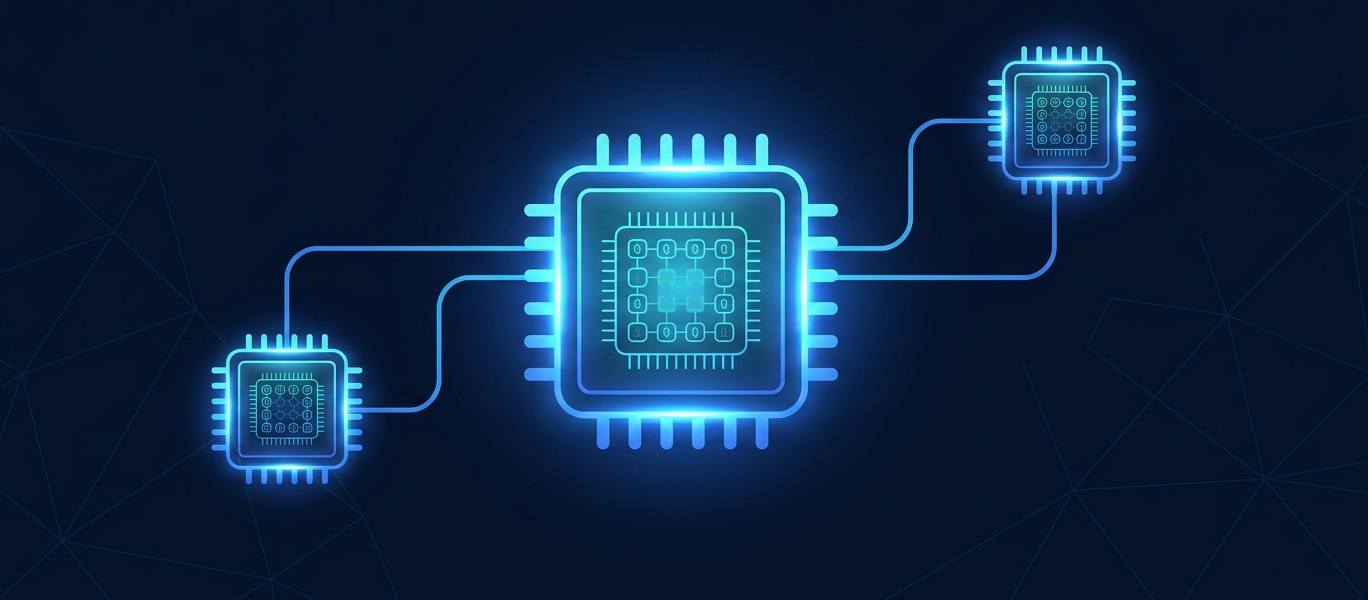
As quantum computing is increasingly faced with the limitations of monolithic architectures, modularity becomes a compelling approach to scalability. Rather than building increasingly larger and more complex quantum processors within a single device, modular quantum computing advocates for a system made up of multiple smaller, independent quantum modules.
In this framework, each quantum module is designed to be relatively easier to manage, calibrate, and stabilize. These modules function as self-contained quantum processors, maintaining local coherence and performing operations reliably within their boundaries.
The true power of modular quantum computing is realized when connecting these individual processors. Communication between processors can take place through classical, quantum, or hybrid channels, depending on the nature of the operations and the requirements for maintaining quantum relationships. Quantum communication protocols, such as entanglement distribution, teleportation, and photonic interconnects, allow processors to exchange and coordinate quantum information, forming a cohesive system that acts as a single, unified quantum computer.

This modular architecture allows engineers to better manage the increasing difficulties of maintaining coherence and controlling interactions in a large monolithic device. It also offers greater flexibility for upgrading, repairing, or expanding a quantum system, as new modules can be added or existing ones replaced without disrupting the overall architecture. More effective management of noise, thermal constraints, and fabrication challenges, can also be achieved since each module can be optimized individually.
The challenge and opportunity lie at the interfaces between modules. Communication is established through controlled links, which can be photonic channels, quantum buses, or protocols designed to transfer quantum states without introducing excessive error or loss. These interfaces must therefore maintain coherence globally, enabling the entire system to function as a coordinated quantum computer.
Modularity marks a significant shift in quantum computing design, prioritizing networks of intelligently connected modules over simply building larger singular devices. It supports scalability and opens possibilities for distributed quantum intelligence, allowing modules to connect across significant distances. As a result, it could make quantum cloud computing, shared quantum resources, and collaborative problem-solving across multiple locations a reality.
Toward a Quantum Internet
Modular quantum computing lays the foundation for a quantum internet. By leveraging the modular architecture, quantum devices can be interconnected, forming a network where each module acts as a node capable of sophisticated quantum operations. This approach is fundamentally different from traditional, monolithic quantum systems, as it enables scalability and flexibility, allowing the architecture to grow and adapt as technology advances.
Such a network promises unprecedented capabilities, including secure communication through quantum encryption, distributed computational tasks, and novel forms of collaboration between remote quantum systems. One of the most intriguing aspects is the ability to share entanglement across nodes, which would enable the creation of global quantum states that span multiple systems.
This interconnectedness could facilitate new protocols for quantum teleportation, synchronization, and resource sharing, fundamentally changing how sensitive data and complex problems are handled. The quantum internet would offer enhanced security, as quantum information cannot be intercepted or duplicated without detection, thus providing a robust solution to modern cybersecurity challenges.
Modularity as The New Normal
Modular quantum computing marks a fundamental change in the way quantum systems are conceived and engineered. This approach is essential for building quantum devices that are not only scalable and resilient, but also capable of operating in a globally connected network. In a modular architecture, engineers can more easily manage upgrades, repairs, and expansions without affecting the overall system. This also allows for the seamless integration of advanced communication protocols, such as photonic channels and quantum buses, which help overcome many of the limitations associated with traditional monolithic architectures.
As modular quantum systems lay the foundation for a future quantum internet, they are poised to revolutionize several key areas: secure communication, distributed computation, and collaborative innovation. The networked architecture allows modules to act as nodes, each capable of sophisticated quantum operations, and enables global quantum states to be shared across vast distances. This interconnectedness supports new protocols for quantum teleportation, synchronization, and resource sharing, making it possible to solve complex problems collaboratively and securely.
With the ongoing development of modular quantum systems, we can expect breakthroughs in cybersecurity—since quantum information is inherently protected from interception—and a transformation in how data is exchanged and processed globally. Ultimately, the continued advancement of modular quantum architectures will unlock unprecedented capabilities, driving the progress of quantum technologies and shaping the landscape of information processing.
Discover more from Baha Jabarin
Subscribe to get the latest posts sent to your email.
Watch my video on modular quantum computing. Let me know your thoughts on where you see this modular approach heading.
https://youtube.com/shorts/quhNhIjUxiE?feature=share